• Recipe List
  • Sophie

Stories from the Stove

Stories from the Stove

Tag Archives: Food

Nasturtium-leaf sandwiches

02 Monday Apr 2012

Posted by Sophie James in Recipe

≈ 3 Comments

Tags

Food, Ingredients, M.F.K Fisher, Nonfiction, Recipes, Stories, Travel, Writing
IMG_6815

Avram Dumitrescu

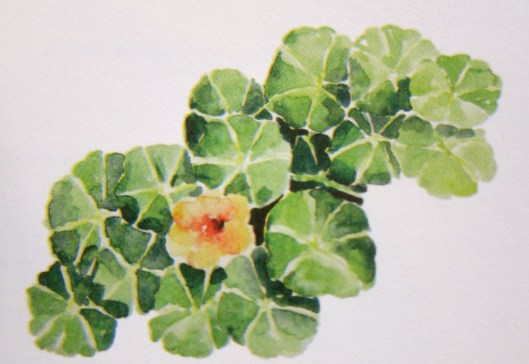
I discovered nasturtiums and the food writer M.F.K Fisher around the same time, so it seems fitting to include them both here. This recipe might also sum up Fisher’s approach to life and cooking, as it is both daring and in some senses obvious; nasturtiums grow wild, as well as being the easiest things to cultivate, and most of us have a loaf of bread knocking about. The rest is up to you.

Her life is hard to summarize without reducing it to the amount of times she moved house. She was a true vagabond, shuttling between France, Switzerland and her native California; back and forth she went like a ping-pong ball. Possibly because of this, she had a complete lack of vanity about where she cooked and with what. Some of her early, settler-influenced dishes read like one of Edward Lear’s nonsense poems – clabber custard, cocoa toast, tomato soup cake – but her message is disarmingly relevant. Eventually, we must ditch the gurus and find our own voice. Fisher herself was entirely self-taught, spurning even her French landlady’s attempts to school her in the basics. She simply made it up as she went along. The limitations of her surroundings, and the lack of equipment – in one house the radiator stood in for a stove, and in another, the cold meant she cooked wearing a fur coat and gloves – dictated what she was able to prepare, and this was what excited her most; that making do is liberating, and we are confined by choice.

She is the antidote to our learned helplessness – our need for ‘experts’ – and the champion of trial and error. She wanted us to feel our way, physically and psychically, through the food we cooked. About this, she said “I believe that through touch, or perhaps because of its agents, other senses regain their first strengths.”

A devotee of offal at a time when Miracle Whip was considered classy, and a life-long hatred of American salads sets her apart in ways that even now appear radical and eccentric. She is often described as America’s answer to Elizabeth David, but I think this is to do her a disservice. To my mind, her writing has the tough lyricism of the survivor. Flinty, resolute, economical, she was a woman raised under big skies in a brave, new world.
IMG_6883

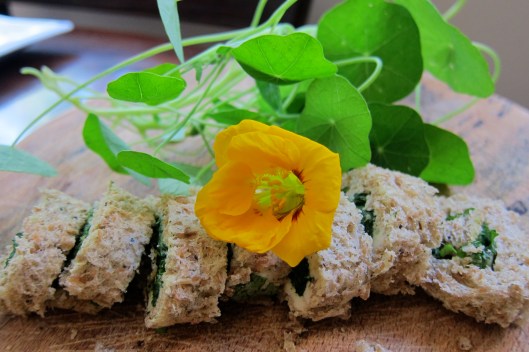
Nasturtium-leaf sandwiches

I know it may be controversial, championing the ‘wich in these carb-free times, but perhaps it’s due a revival. There can be nothing more satisfying than a torn hunk of baguette, with some sharp cheddar (crisps optional), or a few slivers of smoked salmon inside a thin, wheaty shell. And then there is toast, at which even the thought makes my cheeks sing, and gives butter a reason to live.

If you’re craving something cleaner, you could make a nasturtium salad; it works in much the same way as watercress, being from the Indian cress family. In fact, the word originally comes from the Latin nasus tortus, meaning “twisted nose”, supposedly because of what it does to your sinuses. Creamy clouds of pepperiness and a shock of blossom covered in the lightest of dressings is springtime in a bowl.

From With Bold Knife and Fork, M.F.K Fisher (1969) 

Makes about 40

1 loaf white Pullman* bread, crust removed, sliced lengthwise into three 1-inch slices

¾ cup butter, softened

2 cups nasturtium leaves, tightly packed

Nasturtium blossoms for garnish

“Using a rolling pin, firmly roll each slice of bread to flatten. Spread each slice on one side with butter. Reserve 6 nasturtium leaves for garnish. Finely chop the rest of the leaves. Spread the chopped leaves over the buttered side of each bread slice. Then, starting from a long side, roll up each slice into a log. Wrap each log separately in plastic wrap and refrigerate until the butter has hardened, about 2 hours. (Once the butter is hard, the logs will stay rolled.) Cut the chilled logs crosswise into ¾-inch-thick slices. Arrange the slices on a platter and serve garnished with nasturtium blossoms and the reserved leaves.”


* Otherwise known as a ‘sandwich loaf’ – the name Pullman comes from their use in the cramped kitchens of Pullman railway cars. These days, most sliced bread is actually a Pullman loaf: square, and baked in a long, rectangular, lidded pan. I used some sliced rye and wheat bread I had in the freezer and lopped off the crusts.

Share this:

  • Share on X (Opens in new window) X
  • Share on Pinterest (Opens in new window) Pinterest
  • Share on Facebook (Opens in new window) Facebook
  • More
  • Share on Reddit (Opens in new window) Reddit
  • Share on LinkedIn (Opens in new window) LinkedIn
  • Share on Tumblr (Opens in new window) Tumblr
  • Print (Opens in new window) Print
  • Email a link to a friend (Opens in new window) Email
Like Loading...

A word about cherimoyas

22 Thursday Mar 2012

Posted by Sophie James in Recipe

≈ 2 Comments

Tags

Custard apple, Dessert, Food, Fruit, Ingredients, Recipes, Stories

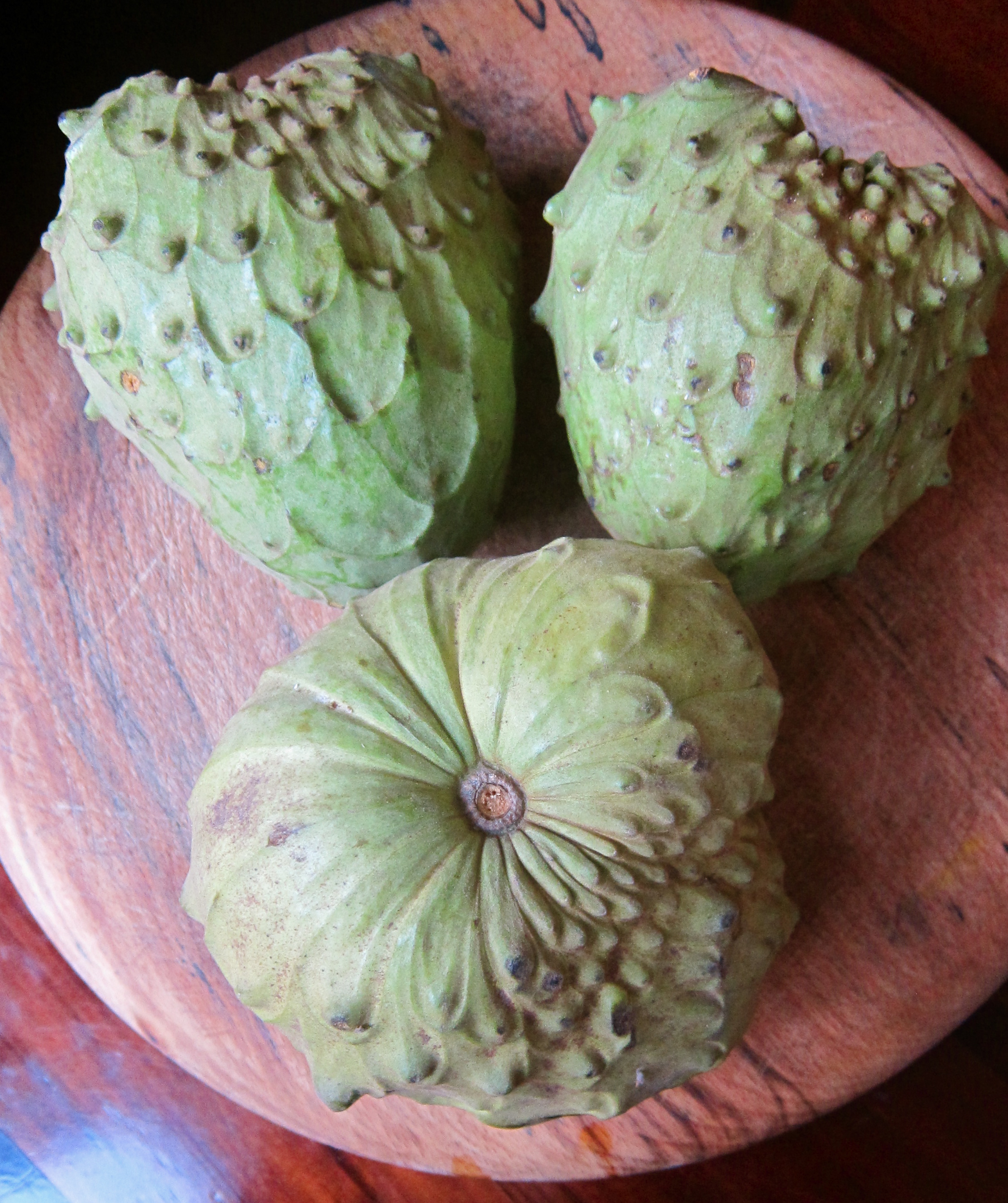
IMG_6430The cherimoya doesn’t so much have a skin as a hide. The green scales covering this frankly prehistoric-looking fruit conceal a milk-white, meltingly sweet interior. Though it’s part of the Annona family, to which the custard apple (Annona reticulata) also belongs, the first mouthful reminded me of drippingly ripe pear, with the scented cream of banana and the gentle acid of pineapple blooming moments later. The texture is both coldly crisp and rich.

As nature has given us a fool* in disguise, it would be crazy to tinker too much with it, I think. You can slice off the top and eat the contents with a spoon, which is fun, but the slippery – and large – black seeds take some navigating. You could pick them out and then eat the fruit out of hand, like I sometimes do with an avocado if I’ve forgotten cutlery.IMG_6725

Alternatively, the gentlest of interventions would be to tease out the seeds, give the fruit a squeeze of lime, add the zest, and then encourage the cherimoya’s sherbet-like qualities with a spoonful of creme fraiche. Any more doctoring and it would become sadly ordinary; no pies or tarts (or vicars) needed here. Another possibility is to cut it into chunks and add it to a fruit salad, but the challenge would be whether its subtlety and gentleness could hold up against other more dashing and showy specimens.

Though it can look quite menacing, it is actually rather a delicate, frail thing. The skin bruises and breaks easily, and, like a pear, the moment of perfection is fleeting, so always buy it firm to the touch and allow it to ripen out of direct sunlight over three to four days.

Custard apples and sour-sops (Annona muricata) – also in the same genus as the cherimoya – were brought to England by West Indians who had enjoyed them in the Caribbean, though the cherimoya tree itself originated in the uplands of Peru and Ecuador; the name is derived from the Inca language, Quechua, and translates as “cold seeds.” In Southern California, the trees have done well in the sub tropical and mild temperate climates of the region since 1871. Their season is short – March to May – and as they don’t travel well, you won’t find them in supermarkets, which makes them something of a curio; both a good and a bad thing. I’m not a fan of the exotic for its own sake, and much is made of its shape and strange armour. Ultimately, I think the cherimoya is a find because it carries within it a palimpsest of flavours and textures we’ve encountered elsewhere. My first mouthful made me think of ambrosial, just-setting custard, which then took me back to Ambrosia Devon Custard in a tin, which as a child – and you’ll have to trust me on this one – tasted amazing.

Cherimoya fool

Traditionally a fool involves cooking the fruit and then either crushing or sieving it before adding whipped cream. If you’re a fan of texture, rather than uniform smoothness, as I am, then simply remove the (inedible) seeds and crush the fruit with a fork, which will start to turn to mush naturally anyway. It’s important to use fruit whose skin is soft to the touch, but not overly bruised or brown; the same principle as an avocado. Cooking here is unnecessary and will strip the cherimoya of its nutrients (it is exceptionally high in vitamin C) as well as the spellbinding freshness. I think lime juice accentuates the cleanness, but a squeeze of orange would work as well.

Serves 2 (fills 2 ramekins)

1 large heavy-sized cherimoya or 2 medium ones

Juice and zest of 1 small lime

1 very heaped tablespoon of creme fraiche (or whipped heavy/double cream)

Cut the cherimoya in half, and then scoop out the flesh, picking out the seeds as you go. Discard the seeds along with the skin. Crush or roughly chop the fruit (you may not have to do either if you have an exceptionally ripe one). Add the lime juice and the zest, along with the creme fraiche, and make sure all the ingredients are evenly distributed throughout. Serve in small glasses or ramekins. Sprinkle with extra zest for prettiness.

* A fool is an old English dessert made of crushed fruit and cream. Gooseberry fool is the quintessential summer pudding and rhubarb fool is lovely in winter. Apparently wild apricot fool is the bees knees.

Where to get them in LA: Rancho Santa Cecilia (based in Carpinteria) sells them at the Hollywood farmer’s market on Saturdays and the ever-helpful Mud Creek Ranch (from Santa Paula) do too, as well as appearing at the Wednesday farmer’s market in Santa Monica.

Share this:

  • Share on X (Opens in new window) X
  • Share on Pinterest (Opens in new window) Pinterest
  • Share on Facebook (Opens in new window) Facebook
  • More
  • Share on Reddit (Opens in new window) Reddit
  • Share on LinkedIn (Opens in new window) LinkedIn
  • Share on Tumblr (Opens in new window) Tumblr
  • Print (Opens in new window) Print
  • Email a link to a friend (Opens in new window) Email
Like Loading...

A word about limes

15 Thursday Mar 2012

Posted by Sophie James in Recipe

≈ 3 Comments

Tags

Citrus, Cooking, Food, Fruit, Ingredients, Los Angeles, Recipes, Stories

IMG_6614

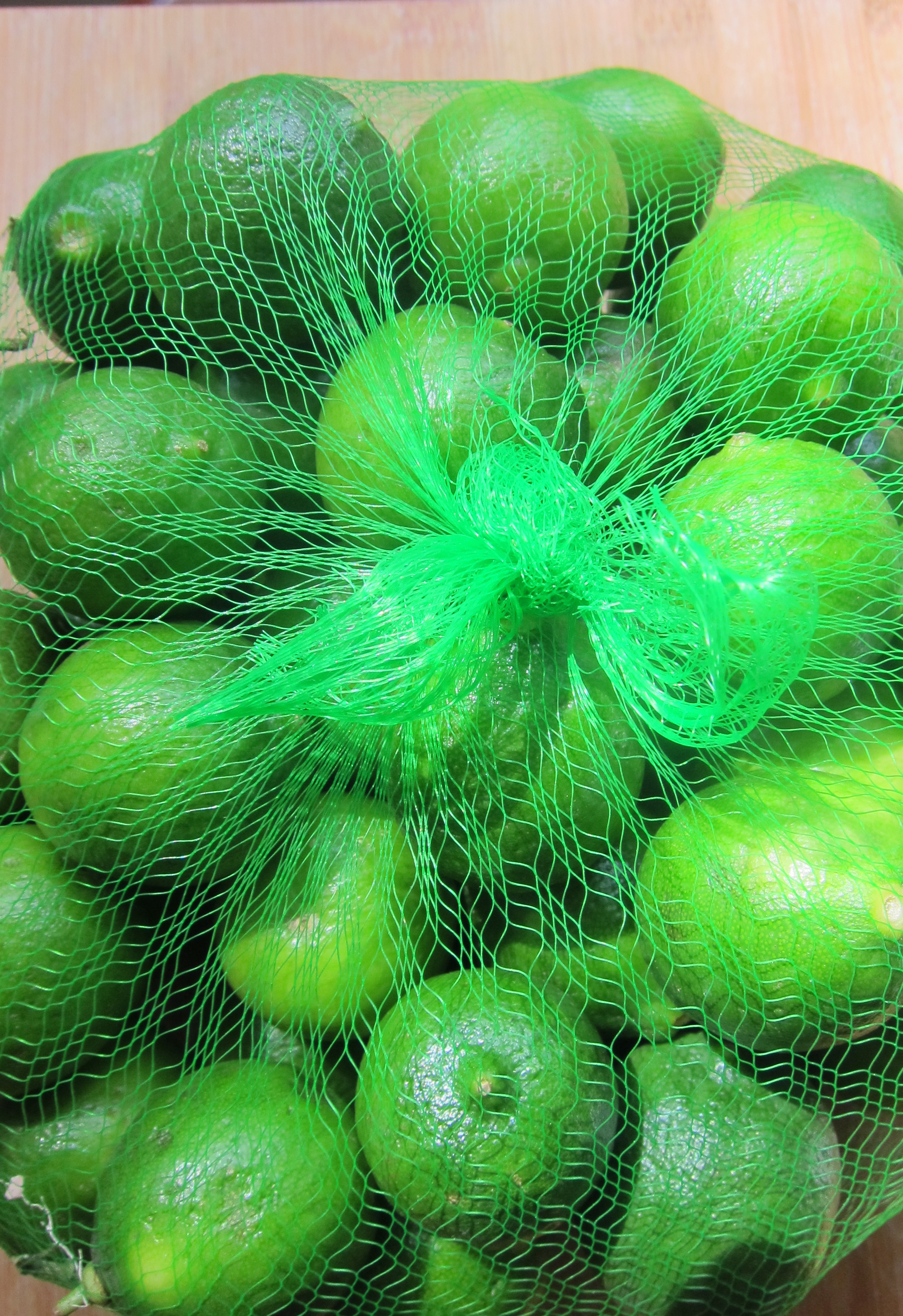
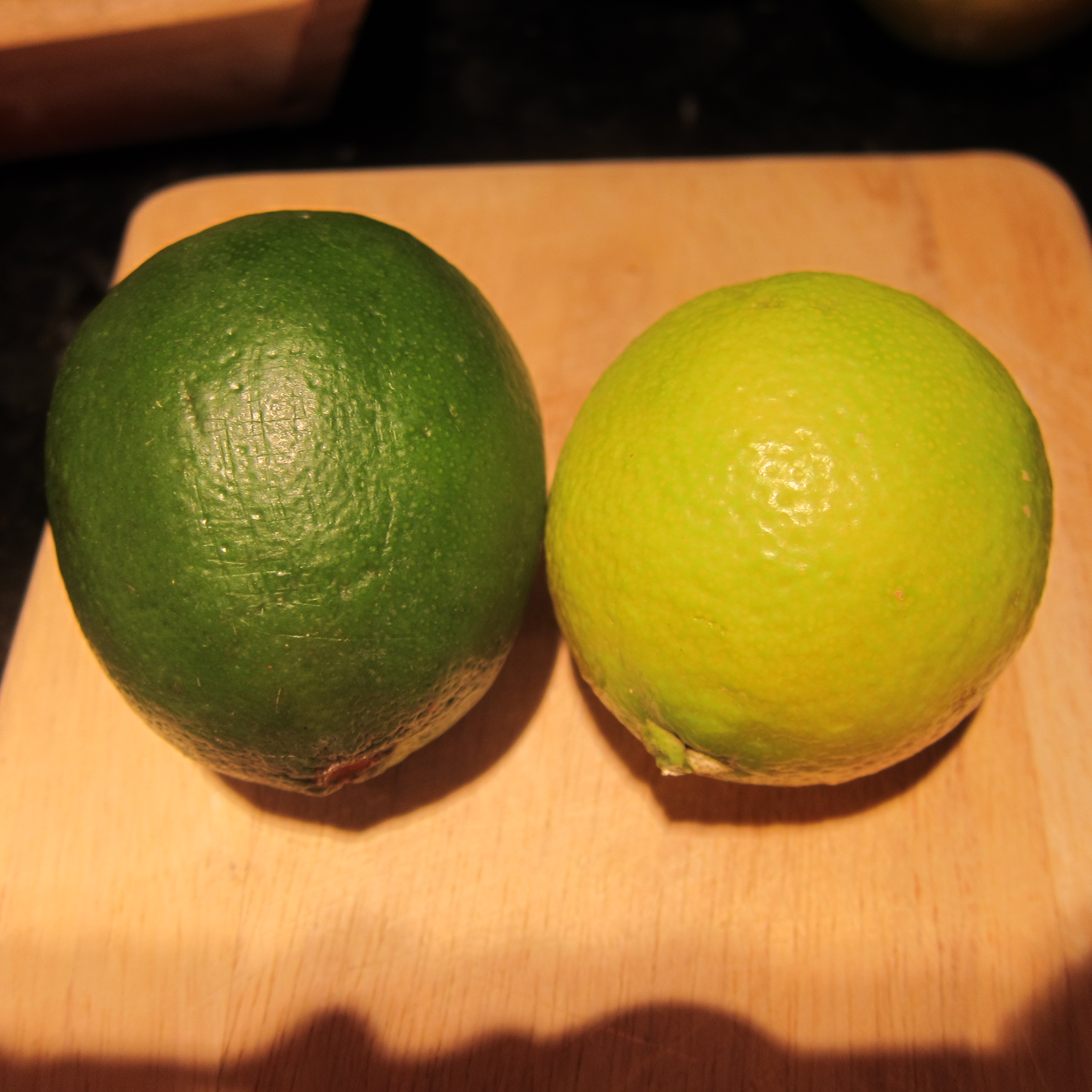
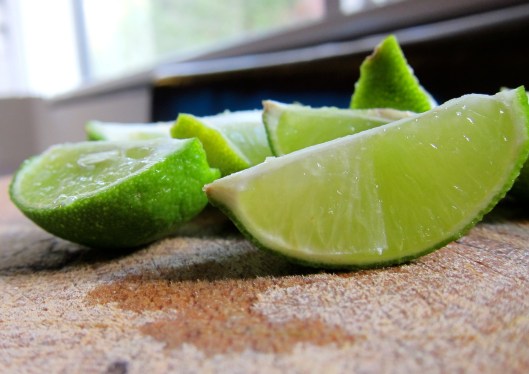
Although lemons and limes are often used interchangeably (and both names come from the Arabic word limah), limes are noticeably different: stronger, sharper, almost darker in taste. Whereas lemons grow well in a Mediterranean climate with long, dry spells and poor soil, true limes favour the tropics. The little beauties above came from an expedition we took to a Mexican supermarket in the valley. So taken were we with the meat section – pickled pigs’ ears daintily presented in trays, sheets of beef honeycomb tripe that looked almost marine-like, and the wonderfully labelled “beef feet” – that we temporarily forgot why we had come, which was to find proper Mexican limes. These nuggets of blistering juice are pretty standard in Mexican cuisine: spritzed over avocados, as a way of ‘cooking’ fish in a ceviche, in margaritas, mixed with sea salt and squeezed into a cold beer, mixed with salt again and sprinkled over chunks of mango, as well as being the star of the show in limonada.

I am embarrassed to say I have often been at a loss as to how to best employ limes. It was only when I chanced upon them at the farmers’ market that I gave them any real thought. These were Persian and Palestine sweet limes, the difference here being the lack of acidity which creates an exceptionally mild flavour. What character they have is concentrated in the rind, which has a light, clean, fresh pine aroma, so I used this in a curd and simply ate the fruit which was at least succulent, and, for an added bonus, apparently cures “everything.”

Tarter and more piercing are the California-grown Key limes. Interestingly, these are lemon-yellow, which according to my sage at Mud Creek Ranch – who patiently puts up with my endless battery of questions – is their natural colour here; green rind can actually be an indication of the fruit’s unreadiness. They are hell to pick. The branches have thick, angry thorns that slash the skin and make it itch for days. The fact that they can grow here at all is due to an amazing micro climate at the ranch, where they flourish alongside bananas and cherimoyas.

I was surprised to find that my brief investigation into US recipes for lime yielded little apart from Key Lime Pie, a local speciality from Florida’s coral islands – the keys – which is made with the juice of the fruit (Citrus aurantifolia ‘Swingle‘), eggs and condensed milk. The lime’s acidity cleverly ‘cooks’ the pie, and this is possibly why the first recorded recipe came from local sponge fishermen who had no access to refrigeration or a stove (and obviously went through a lot of condensed milk). Semi-wild limes still grow in the area to this day, though they are no longer cultivated due to the 1926 hurricane which destroyed all the citrus groves. Growers replaced the Key Lime trees with Persian Lime because they are easier to grow and pick, but have none of the original’s arresting flavour.

I don’t know whether it’s because I’m a Northerner (as in I hail from Northern Europe), but I am instinctively drawn to the more lumpen uses for fruit –  a baked pudding, a warm tart, a crater of puff pastry exuding steam, something thick and hopefully syrupy within, so lime marmalade was pretty much a given for me to try, if only to plunder my childhood memories of Rose’s fluorescent version, with its dainty green shred.

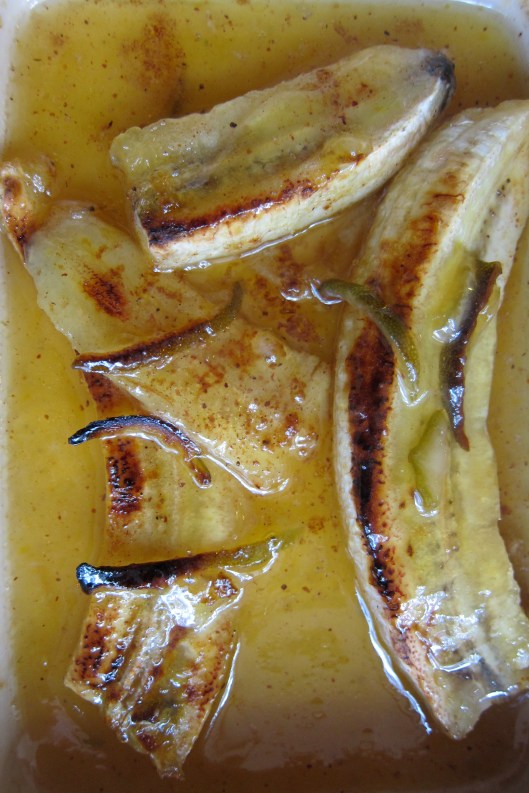
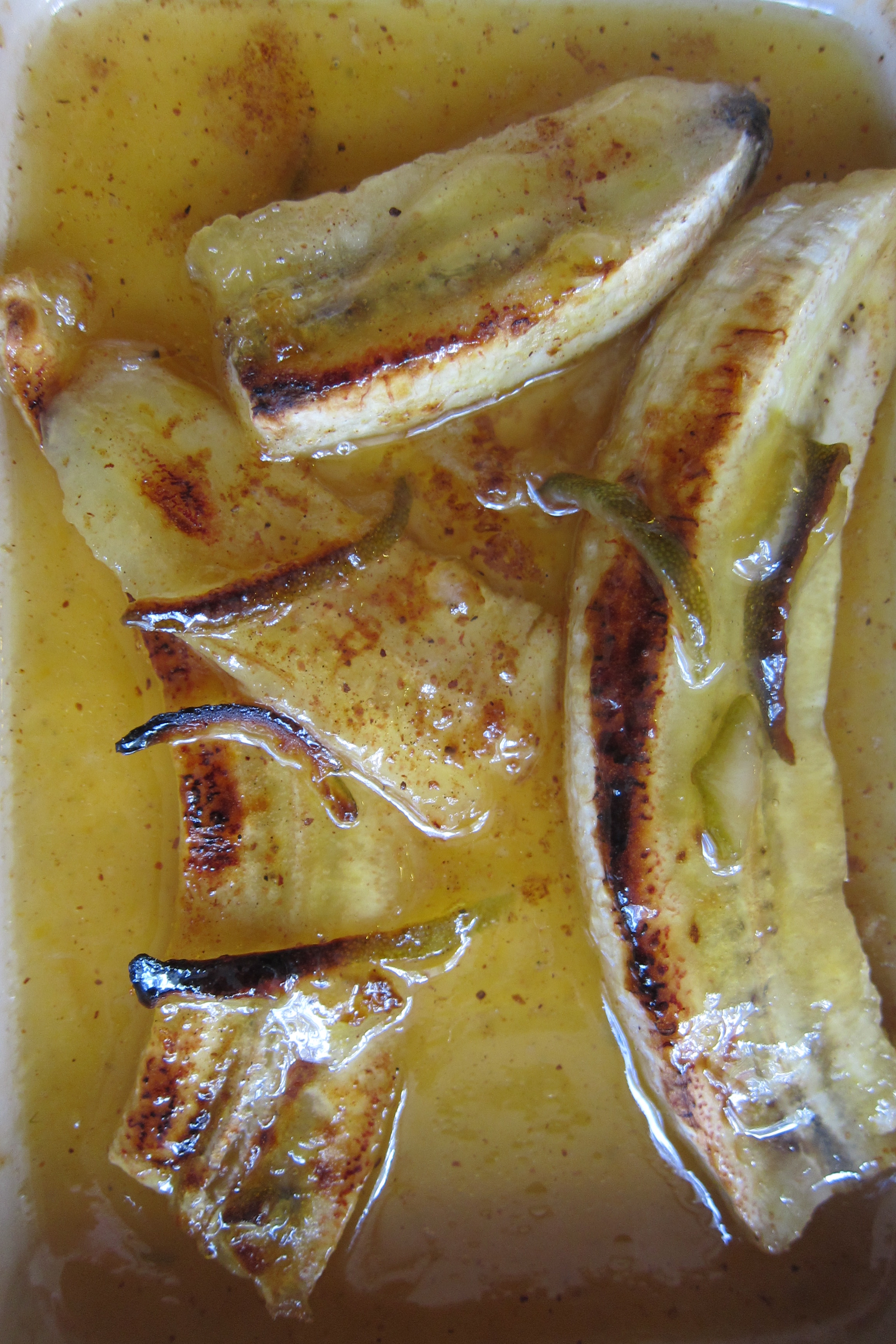
Grilled bananas with lime marmalade and spices

IMG_6587 
Bananas are best eaten in the spring, according to the experts, so this recipe can make you feel doubly smug. If you haven’t got round to making the lime marmalade – or never intend to – then a squeeze of lime would also work here. Serving this with something creamy is essential if you want the syrup to matter. Thick yoghurt is good in the morning, cream at other times, and add almonds if you want a more interesting texture. Lime is a friend of the banana and opposites definitely attract in this case; soft and placid meets brisk and glossy, yet somehow each makes the other more itself in the process.

Serves 2

2 bananas

2 tbs of juice from an orange or tangerine

2 tbs lime marmalade with shred (or lime juice)

Pinch of nutmeg

Pinch of cardamom

1 tbs butter

Peel the bananas and slice them in half, lengthways. Lie them cut side up, in a shallow baking dish. Mix the marmalade and juice together and spoon over the bananas. Dot with butter which has been mixed with the ground spices. Grill until soft and brown (about five minutes). Scatter with toasted slivers of almond if you have them, and serve with either yogurt or cream. You could also try grilling the whole fruit, unpeeled, until black, tearing off a strip of skin to eat the hot, banana fondant within, and serve the syrup separately.

Interesting fact; British explorers and traders in the West Indian colonies used limes to prevent scurvy, which is why we’re still called ‘limeys’ to this day.

Steering clear of the sweet: Yotam Ottolenghi is a fan of lime. His Iranian legume noodle soup uses the juice to cut through soured cream, and lime halves accompany his corn and squash fritters. If you’re a fan of pickles, then pickled limes can be used as the basis of a sour relish for spicy dishes, and anything with an Indian bent.

Mexican limes


Share this:

  • Share on X (Opens in new window) X
  • Share on Pinterest (Opens in new window) Pinterest
  • Share on Facebook (Opens in new window) Facebook
  • More
  • Share on Reddit (Opens in new window) Reddit
  • Share on LinkedIn (Opens in new window) LinkedIn
  • Share on Tumblr (Opens in new window) Tumblr
  • Print (Opens in new window) Print
  • Email a link to a friend (Opens in new window) Email
Like Loading...

Lemon drizzly

06 Tuesday Mar 2012

Posted by Sophie James in Recipe

≈ Leave a comment

Tags

Almonds, Baking, Cake, Dessert, Food, Herbs, Ingredients, Lemons, Recipes

IMG_1525

I’m aware I might be going overdrawn on my ‘lemon’ account with this recipe, but this really is sublime. It also works equally well with limes, if you want something more piercing. In either case, the loaf cake is made doubly moist, first with the addition of ground almonds and then with the soaking it gets from the lemon/lime syrup. It keeps for ages.

I used thyme here too; it is one of those shrubby herbs you can be quite flagrant with, unlike sage or rosemary. Whenever I’ve been tentative, it looks as though a couple of green flies have fallen into the mixture and need fishing out. It should look deliberate, so be generous. Thyme adds a resinous, woodland warmth, and tempers the sweetness. It goes particularly well with lemon; both are part of the Mediterranean palate, and with some light roughing up over heat, the smell can quickly conjure up memories of scorched earth, sea air and the sigh of singed, crackling wood over flame. Needless to say, you can leave it out.

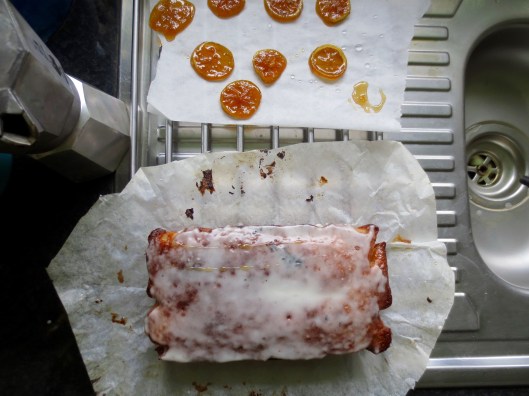
This cake is based on a Nigel Slater recipe, a food writer with the soul of a gardener in my view. I decided on the thinnest layer of lemon icing on top; it has never felt too much and it makes the cake less gooey to handle. Anyway, that’s my excuse. Candied lemons are a good standby.

IMG_1519

Lemon loaf cake

Adapted from Nigel Slater, Crumbs of Comfort, The Observer

At the risk of appearing slightly hysterical, this is the best lemon loaf cake I’ve ever eaten/made. It is simplicity itself and yet tastes quite amazing. People will think you’re professionally trained. 

For the cake:

200g butter, softened

200g caster sugar

3 large free range eggs at room temperature

80g plain flour (rice flour works well here too)

100g ground almonds

2 teaspoons of thyme leaves (optional)

Grated zest of 1 whole lemon (reserve the juice for the syrup)

Half a teaspoon of baking powder

Pinch of salt

1 loaf tin (8″ x 5″)

For the syrup:

4 tbsp sugar

Juice of 1 large lemon (see above)

For the candied lemons (optional)

3 lemons, thinly sliced

100g caster sugar

100ml water

Pre-heat the oven to 350F/175C. Butter and line the loaf tin with baking parchment. Sift the baking powder, salt and flour together. Cream the butter and sugar till they are pale and fluffy. Gradually beat in the eggs, alternating with the flour mixture to stop it curdling. Grate the lemon zest and mash it with the thyme leaves, if using, in a pestle and mortar or with the base of a jar; tearing the leaves helps release their essential oils. Or just add the lemon zest to the cake mixture, along with the ground almonds. Fold the mixture into the lined tin and bake for approximately 40 minutes or until a skewer comes out clean.

While the cake is baking, dissolve the sugar in the lemon juice over a low heat – taste as you go and add more sugar if need be. Remove from the heat and steep for 20 minutes. When the cake comes out of the oven, pierce it all over with a skewer and pour over the syrup. Allow to cool.

If you want to go a bit ‘Elvis’ with it, as I did, add a thin shell of lemon icing on top of the tacky-dry syrup; wet 6 heaped tablespoons of sifted icing sugar with 2 generous tablespoons of lemon juice and spread over the cake, letting it drip down the sides. Keep the cake wrapped tightly in foil for a few days to moisten if you can.

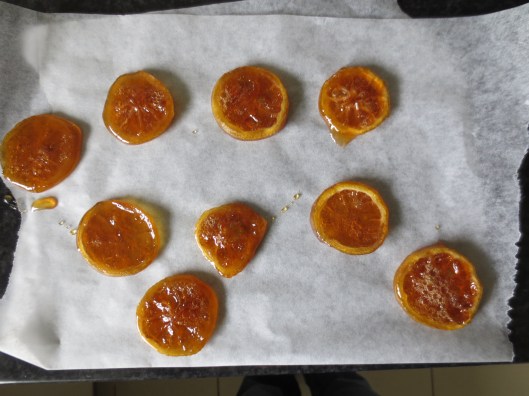
For the candied lemons, bring a pan of water to the boil and blanch the sliced lemons by putting them in the boiling water for five minutes. Drain and set aside. In another pan, bring the sugar and water to the boil, add the lemons and simmer for about 10-15 minutes, or until the white pith turns translucent. The lemon slices will go sticky and shiny. Allow them to cool on greaseproof paper. Store in an airtight container, or place on top of the cake for a pleasant finish. They’re quite chewy.

Optional extra: Add crushed cardamom from 1½ tbsp green cardamom pods (put the seeds in a pestle and mortar and crush to a coarse powder) to the butter/sugar before creaming. I think it gives the cake a slightly mystical, smoky flavour. Shout out to Good Things to Eat by (my cousin) Lucas Hollweg for this lovely addition to a lemon cake.


34.052234 -118.243685

Share this:

  • Share on X (Opens in new window) X
  • Share on Pinterest (Opens in new window) Pinterest
  • Share on Facebook (Opens in new window) Facebook
  • More
  • Share on Reddit (Opens in new window) Reddit
  • Share on LinkedIn (Opens in new window) LinkedIn
  • Share on Tumblr (Opens in new window) Tumblr
  • Print (Opens in new window) Print
  • Email a link to a friend (Opens in new window) Email
Like Loading...

A word about lemons

27 Monday Feb 2012

Posted by Sophie James in Recipe

≈ 1 Comment

Tags

Citrus, Cooking, Food, Ingredients, Lemons, Meyer lemons, Recipes, Stories

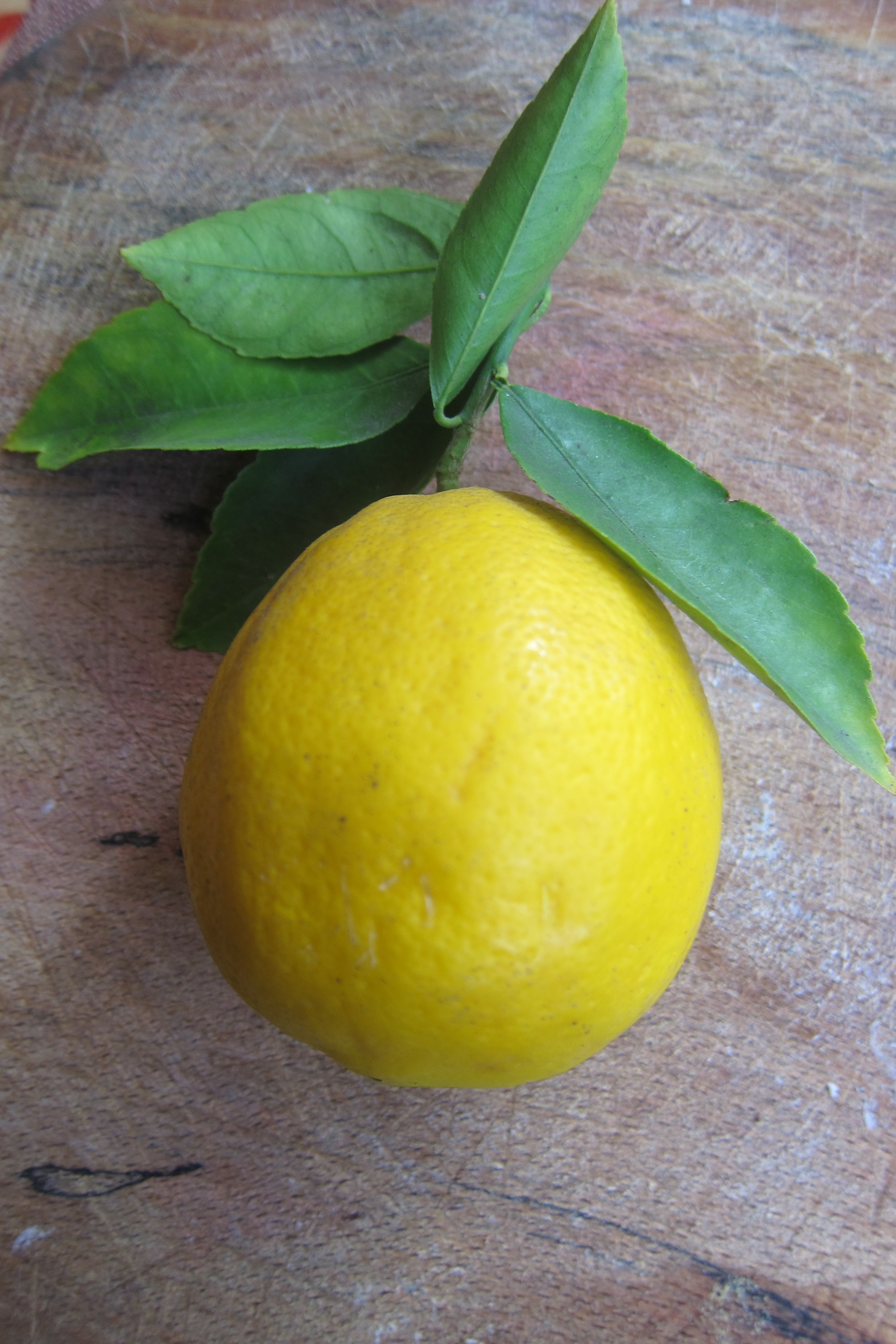
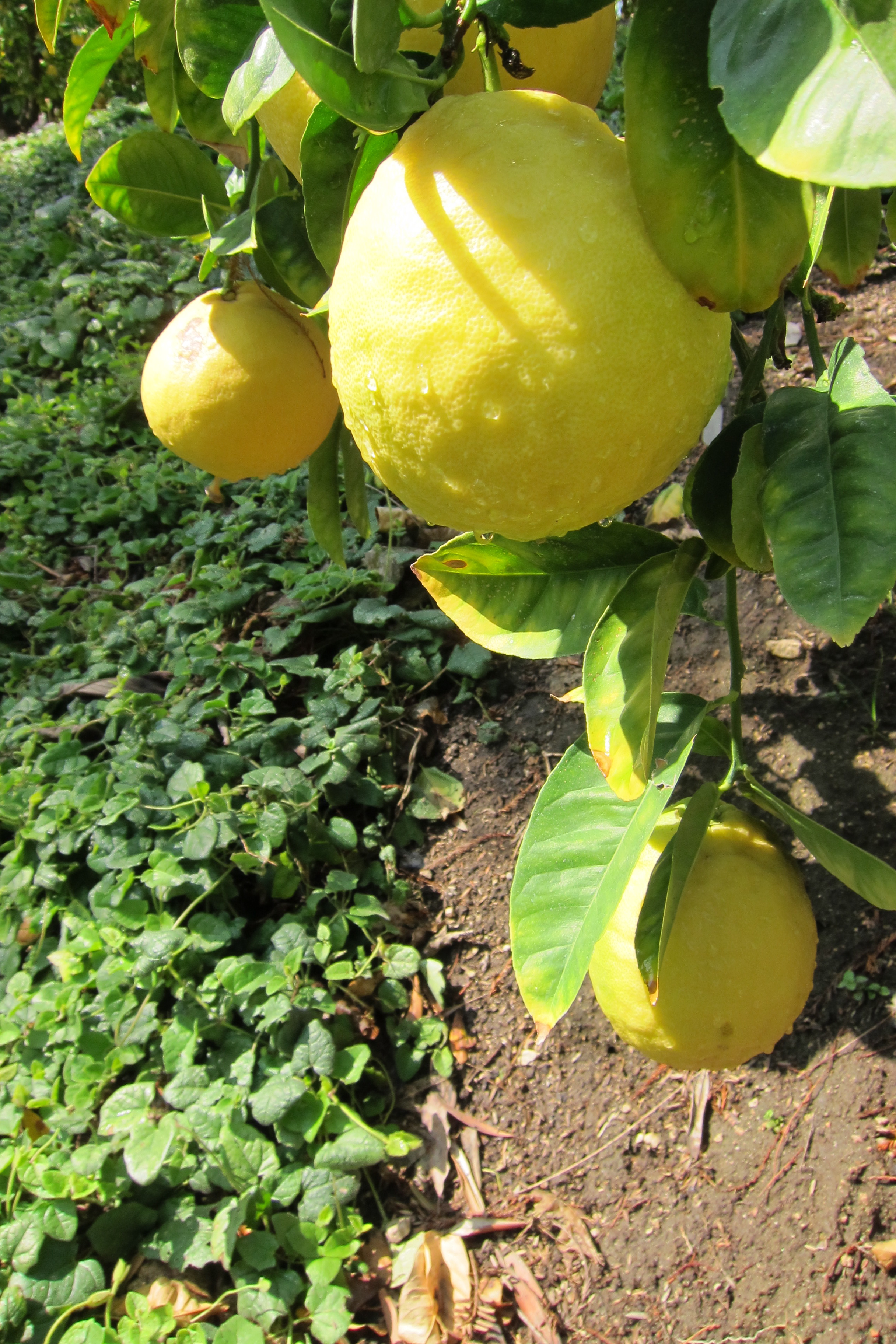
I love lemons. I love the way they sit all plump and jaunty in the bowl, the zing of oil from the rind, that spike of sparkling acid on the tongue. A lemon tree heavy in fruit and blossom is simply a wonder of nature.

To be mercantile for a moment, a ripe lemon is firm but not hard and should feel heavy for its size. Thin-skinned tends to be juicier than thick and bigger isn’t necessarily better (this is also true in life generally). The juiciest is the very thin-skinned Meyer (Citrus Meyerii), an LA stalwart. Not considered a true lemon at all but a hybrid – a cross between a lemon and a mandarin, some say, though its parentage is unknown – it has a sweeter, more complex, layered flavour, less acidic but still tart enough to perk up discoloured fruits and overly sweet or rich puddings. It cleverly cuts through sugar and cream, lifting a dish to subtle heights of piquancy and freshness. More sour is the Lisbon and Eureka. Lisbon is the juicier of the two, while Eureka is the standard lemon most of us have knocking about. It’s also the one most likely to have been infiltrated with fungicides, insecticides and waxes to make it more appealing. A Eureka picked from the tree is an entirely different animal: cobwebby, misshapen and mottled, and not a bright, waxy yellow at all, but a gentle ochre. With its sea-green leaves attached, it’s almost biblical.

It’s sad we have become such shallow meddlers in the sex life of the lemon. Its journey to ripeness, the subtle changes in colour, weight and fragrance are all to seduce us into plucking it in its prime, thus allowing the reproductive cycle to continue. There’s something almost touching in the knowledge that, being picked, the fruit is experiencing physical pressure for the first time; no longer suspended in mid-air, attached to its parent, it must come down to earth.

You could also try

  • Yuzu (Citrus Yunos) if you can get hold of it. It’s a Japanese citron that fruits early – around September or October here. Because of its exceptional tartness, it holds up well to being cooked at high temperatures and is used as a souring ingredient, specifically in the Japanese sauce, Ponzu. It also works well as marmalade and makes a fragrant, rind-heavy syrup, used often in Korean cuisine.
  • Ponderosa (Citrus Pyriformis) which looked like a grapefruit to me, but is actually a lemon-citron hybrid. The Middle Eastern community in LA apparently makes jam out of the thick rind, which has a floral scent. It also makes a fine lemon curd.
  • Sorrento lemons, also known as Femminello St. Teresa. Native to the Amalfi coast in Italy, they’re typically the variety used in making limoncello, a bitter digestif that uses lemon rind steeped in grain alcohol (which apparently you could also use to run your car). Layers of tufo and limestone in the area create the perfect soil for cultivation, which produces an exceptionally aromatic rind. Locals eat thick slices of this citrus, skin and all, with a dusting of sugar.

Ponderosa Lemons

Some Ideas

  • Hang some lemon peel out to dry in a warm place (by a sunny window, say). When it’s leathery, put it in a jar of sugar and use for baking.
  • I have seen children eat neat lemon quarters here as I used to do oranges (making the segment cover your teeth and then smiling eerily etc). I was both impressed and alarmed by this. I’m not suggesting you do the same, just informing you of the phenomenon.
  • Lemon-infused olive oil, also known as agrumato in Italy, is best made at home, and used within a couple of days. In Skye Gyngell’s recipe, you finely peel the zest – no pith – of 3 lemons using a vegetable peeler. Put in a pan with 1 cup (250ml) of extra virgin olive oil, and heat very gently to body temperature (about 99F). Remove and let steep for about an hour before using. Lovely drizzled over grilled fish, chicken, Burrata, buffalo mozzarella, ricotta or fresh Mexican cheese.
  • Lemon sandwiches, courtesy of Mrs Grigson: “Cut fresh, soft-skinned lemons into very thin slices and sandwich them between thin wholemeal bread slices, thickly buttered. Serve with smoked salmon and marinaded fish.”
  • North African Preserved Lemons

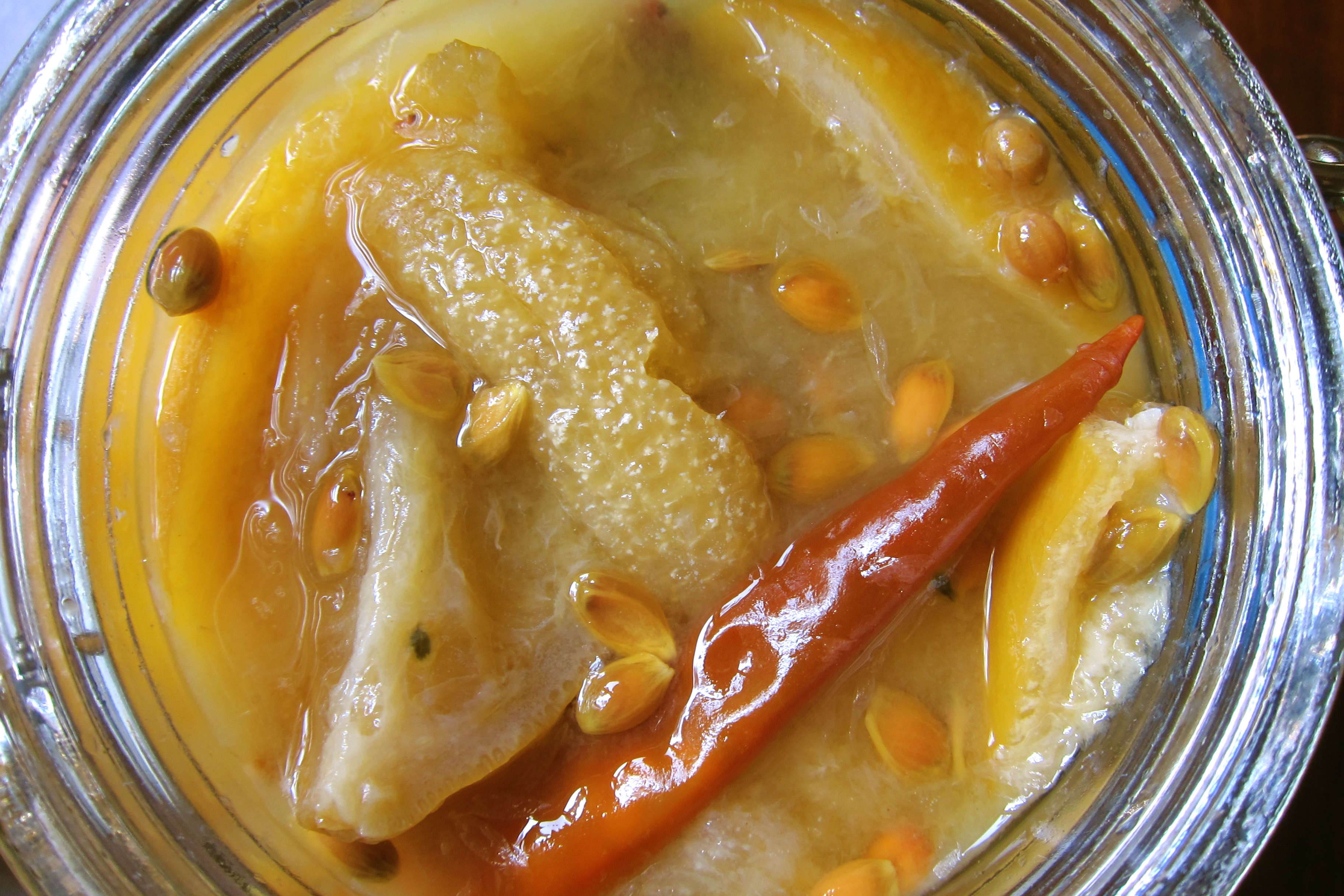
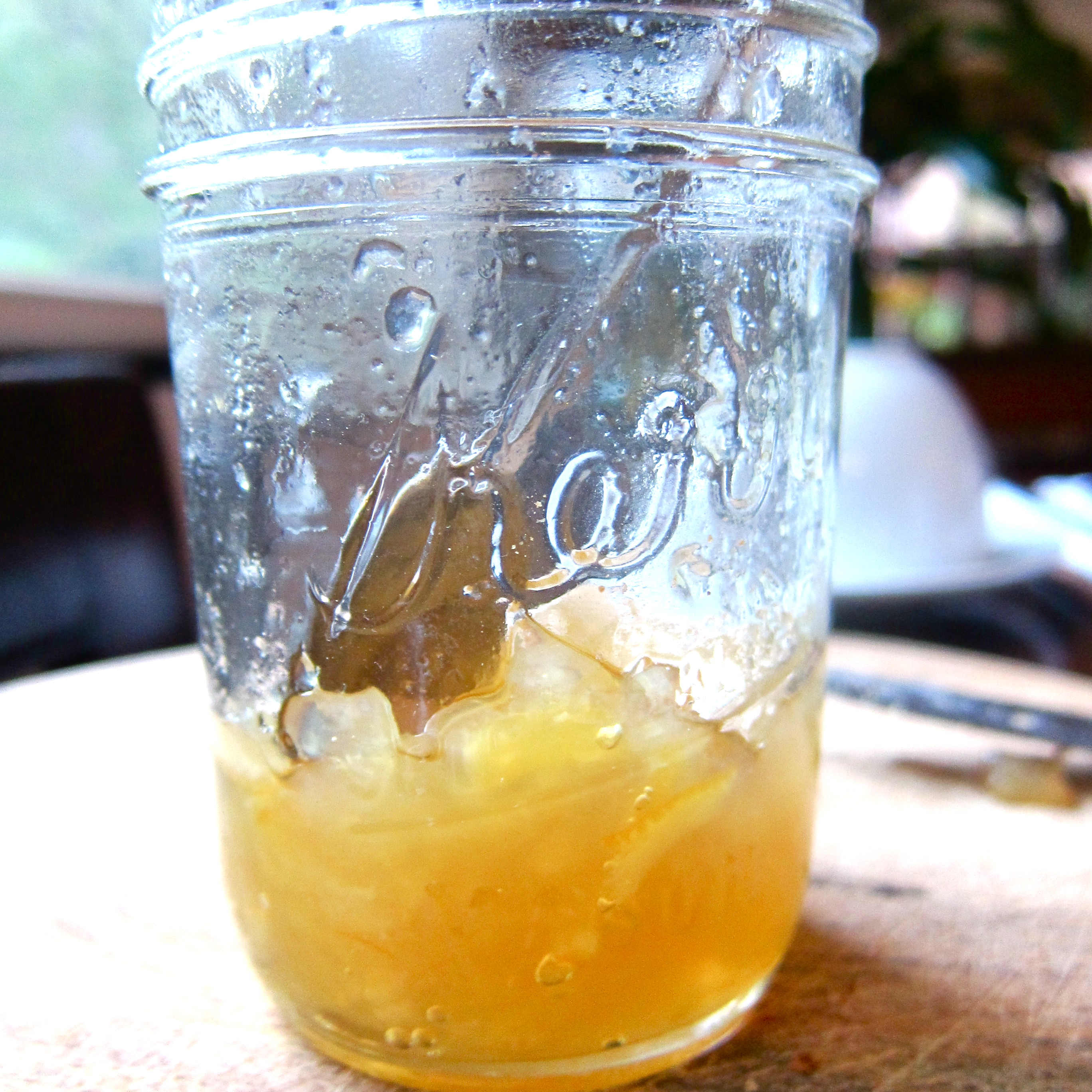
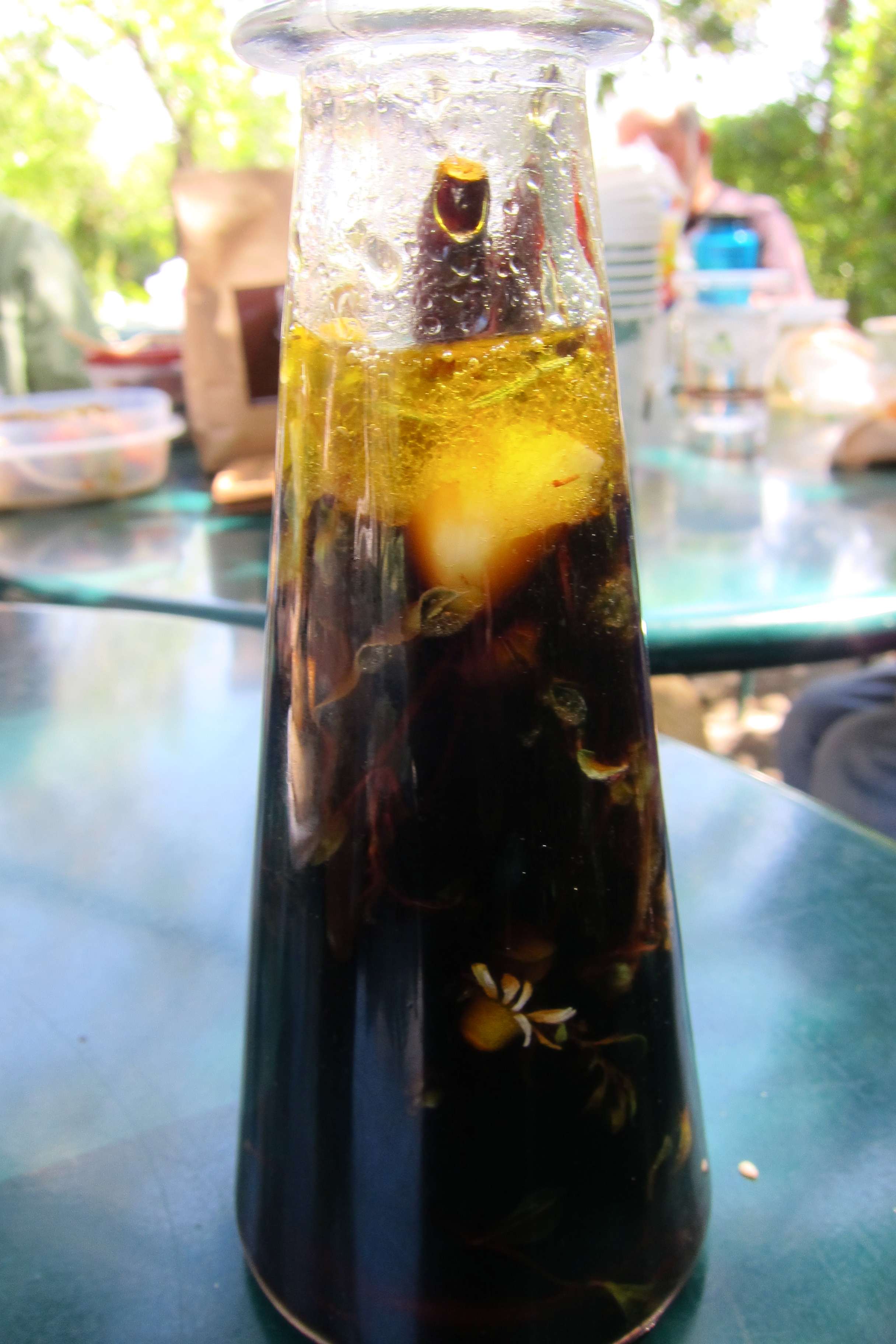
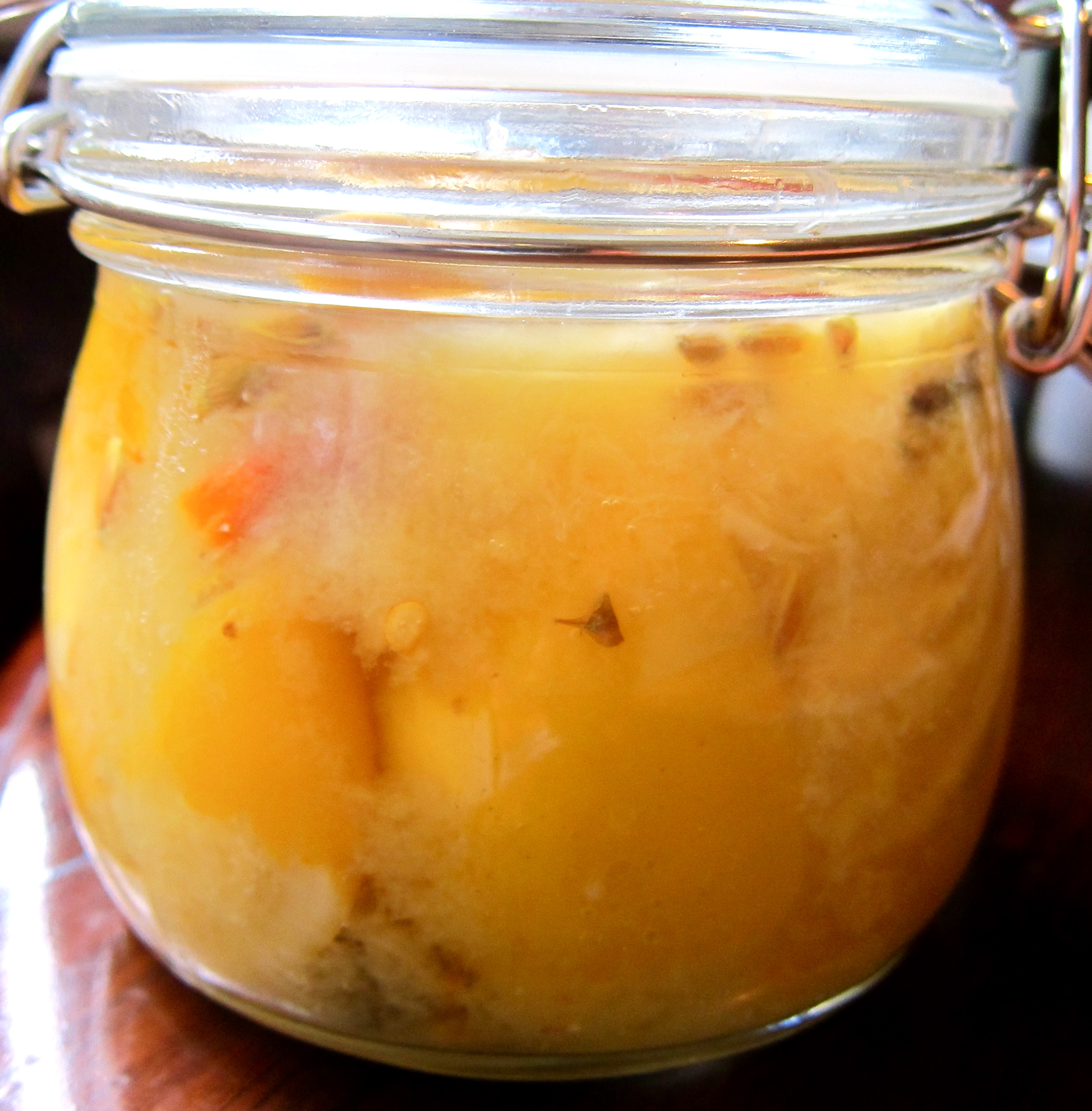
 A doddle, and fantastic strewn over ice cream, in tagines, added to sauteed vegetables, couscous, and mashed into a herby butter. Use Eureka lemons because their thick skins are a bonus here, but make sure they’re organic and unsprayed as the peel is what you’ll be eating, not the flesh. Cut 8-10 washed lemons into quarters from top to stem, without going all the way, and pack the cuts with a generous tablespoon of coarse sea salt (never table salt). Squash the lemons into a large, glass jar, giving them a good ramming to get the juices flowing. Add any or all of these: a cinnamon stick, a whole dried chili, a bay leaf, a few cardamom pods and coriander seeds, then seal and leave overnight. For the next 2-3 days, keep pressing the lemons down, as they begin to deflate. Now top up with fresh lemon juice so that the fruit is fully submerged and leave for about a month, after which time they’ll be ready to use. Keeps for about six months, looking vibrant and virtuous on your kitchen shelf.


Share this:

  • Share on X (Opens in new window) X
  • Share on Pinterest (Opens in new window) Pinterest
  • Share on Facebook (Opens in new window) Facebook
  • More
  • Share on Reddit (Opens in new window) Reddit
  • Share on LinkedIn (Opens in new window) LinkedIn
  • Share on Tumblr (Opens in new window) Tumblr
  • Print (Opens in new window) Print
  • Email a link to a friend (Opens in new window) Email
Like Loading...

Lemon Marmalade

23 Thursday Feb 2012

Posted by Sophie James in Recipe

≈ 1 Comment

Tags

Cooking, Food, Ingredients, Marmalade, Recipes, Stories


I’m rather old guard in my tastes when it comes to marmalade. I find the alchemy of rind, sugar and, say, lemon juice bubbling itself to a thick amber syrup, and the smell of bitter citrus caramel more than enough to satisfy my needs. It took me about five years just to get over the fact that I’d made a jar of marmalade that was edible. But there is always more to discover – more complexity, more ways, whole fruit, less sugar, honey. I recently had a cooling spoonful of Blenheim apricot jam, and hidden in the lushness were apricot kernels that, when bitten, released their almond essence like a mini gun-shot.

But it’s taken me a while to get to herbs. This idea was introduced to me via the genius of Jessica Koslow. Her company Sqirl (based here in LA) is doing profound and wonderful things with marmalades and jams. I can only ape her originality and skill. Chamomile (meaning ‘ground apple’) adds a fruity, soft, almost soothing backnote here and in no way detracts from the citrus strength of the preserve. Harvest whole flower heads and keep them intact; crushing them releases the oils and there goes the flavour. If in doubt leave them out, or try something else in their place. Lemon balm would be interesting, either fresh or dried.

Chamomile

The Bergamot and Orange Marmalade recipe acts as my control – if I went into that much detail each time, we would probably both be reaching for the Mogadon, so I will simply give you the ingredient list here. You may also want to make the marmalade in one day rather than two, in which case omit the overnight soaking. Fills about 6 8oz/half pint jam jars.

Lemon Marmalade with Chamomile

12 lemons

1.35 kg (3lbs) organic cane sugar

20g (1 1/2 tbs) dried Chamomile (added to the muslin along with the pips and pith)

3 pints (6 cups) water (with 1 pint/2 cups added later if necessary)

A bit of history

Lemon marmalade appeared soon after the 13th century with the arrival into England of oranges and lemons. The oranges were bitter Sevilles from Spain and Portugal, or belonging to the Venetian spice ships. Jars of Citrenade were also imported; this was a kind of lemon marmalade, but solid and eaten in pieces, rather like the Portuguese ‘marmelo’ that began life in the Middle Ages. Marmelo was a stiff paste of quinces – citrus came later – made with honey and spices, cut into blocks and served as sweetmeats or fruit Pastilles (nothing like Rowntrees).


Share this:

  • Share on X (Opens in new window) X
  • Share on Pinterest (Opens in new window) Pinterest
  • Share on Facebook (Opens in new window) Facebook
  • More
  • Share on Reddit (Opens in new window) Reddit
  • Share on LinkedIn (Opens in new window) LinkedIn
  • Share on Tumblr (Opens in new window) Tumblr
  • Print (Opens in new window) Print
  • Email a link to a friend (Opens in new window) Email
Like Loading...

Lemon Curd

20 Monday Feb 2012

Posted by Sophie James in Recipe

≈ 1 Comment

Tags

Breakfast, Citrus, Food, Fruit, Ingredients, Lemons, Recipes

IMG_6120

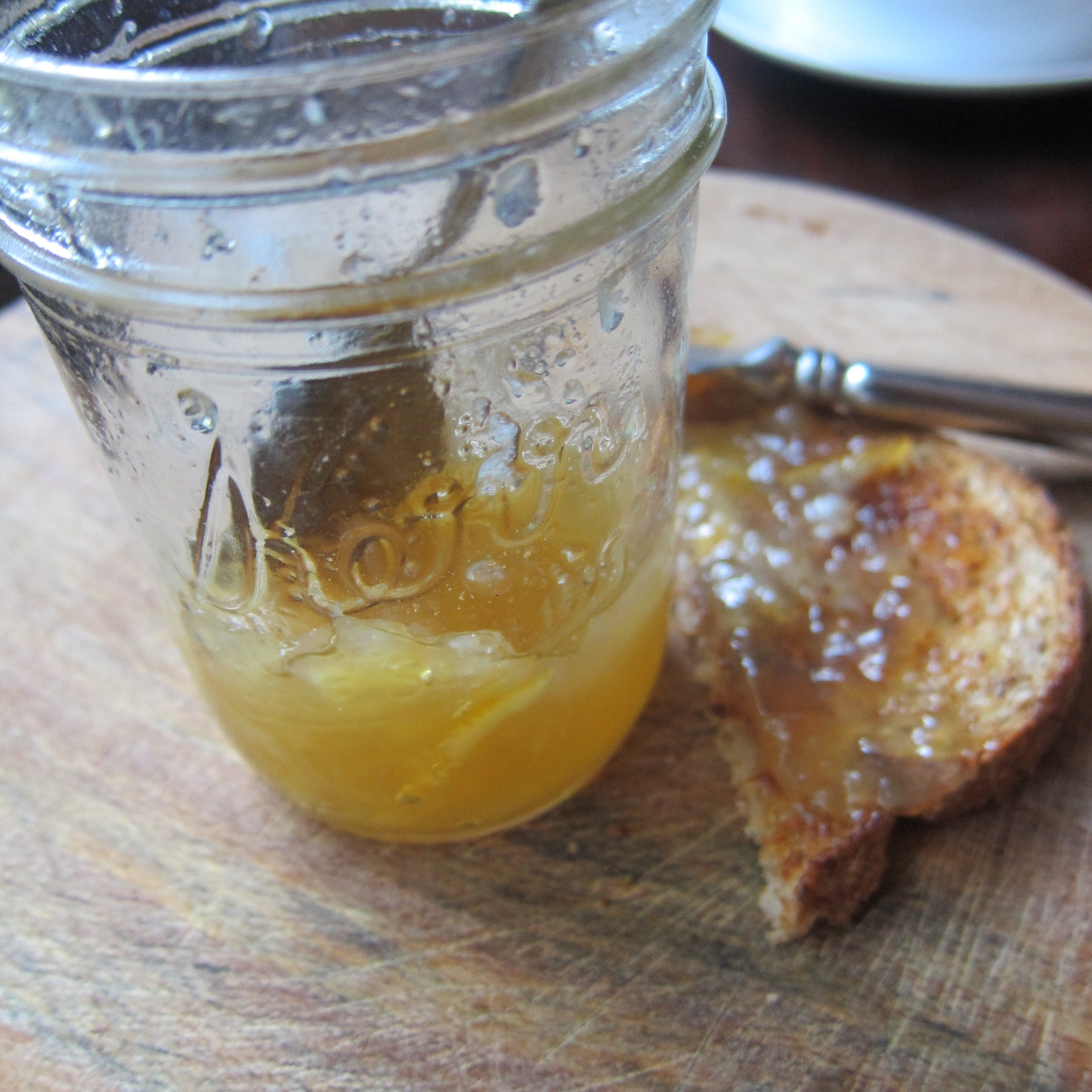
Lemon curd is so simple to make, it’s almost off-putting. Hard to imagine that whisking eggs, butter, sugar and lemon juice in a pan on the stove for a bit could yield anything other than a hot mess. And yet if there was ever such a thing as sunshine in a jar, this is it: bright, tangy, soft as velvet, and delicious eaten briskly cold on hot toast. 

Fruit curd was originally made in stone pots that stood in pans of hot water and were then stored on the still-room floor – a room that was used as a distillery for herbs, medicines and alcohol in medieval times, and later for the storage of jams and jellies. And why curd? In this instance, the word appears to come from curdling (ironically the only thing you don’t want it to do). Some like their curd yolkier than this, but for my money Delia Smith’s ratio is unimprovable. I find whisking rather than stirring creates a lighter texture with a touch more wobble to it, but if solid is what you’re after, use a wooden spoon.

Lemon Curd

Adapted from Delia Smith’s recipe

Makes about 3 8oz/half pint jars (with some left over for immediate use)

Grated zest and juice of 4 large, organic, unwaxed lemons

4 large eggs

350g organic cane sugar

225g unsalted butter at room temperature, cut into cubes

Sterilise the jars by putting them through a cycle in the dishwasher and then transferring them to a warm oven for ten minutes. Whisk the eggs lightly before adding them to a non-stick pan. Finely grate the zest of the lemons (no bitter white pith), squeeze out the juice and add both to the pan along with the sugar. Very gently heat while continuing to whisk with a balloon whisk until it starts to thicken (8-10 minutes). Slightly increase the heat and continue to whisk for a couple more minutes, but do not let the curd boil or you’ll have scrambled eggs.

Remove from the heat, and add the cubed butter, stirring to mix. Make sure the butter has completely melted into the mixture before straining the curd into the sterilised jars. If you like a grainier texture, add some fresh zest. Seal immediately. Even if the curd feels thinner than you would like, it will continue to thicken as it cools. You can’t ‘can’ home-made curd; commercial curd has thickening agents and artificial preservative in order to make it shelf-stable. But what the heck. Lemon curd keeps for up to a month in the fridge and is lovely given as a gift. I know of no one who can refuse it.

Thoughts on lemons

Curd made with the sweeter, milder Meyer lemon blooms gently in the mouth. If you want more of a kick, go for Eureka, Lisbon or Ponderosa. Add intrigue with some lime juice and zest.

What else to eat it with

Spread on a grilled slice of cake or dollop/wallop it into thick berry-strewn yoghurt. American-style pancakes (small, densely stacked, evil) straight from the pan and served with curd and a curl of creme fraiche would make a decadent brunch. And finally, a pot of lemon cream: Mix three heaped tablespoons of lemon curd with the same of Greek yogurt and creme fraiche, some lemon zest and a spritz of lemon juice, and you have a heart-stopping (hopefully not literally) devil of a dessert, which also works well as an accompaniment to a warm pudding. Ta da.

Share this:

  • Share on X (Opens in new window) X
  • Share on Pinterest (Opens in new window) Pinterest
  • Share on Facebook (Opens in new window) Facebook
  • More
  • Share on Reddit (Opens in new window) Reddit
  • Share on LinkedIn (Opens in new window) LinkedIn
  • Share on Tumblr (Opens in new window) Tumblr
  • Print (Opens in new window) Print
  • Email a link to a friend (Opens in new window) Email
Like Loading...

A Word About Dates

16 Thursday Feb 2012

Posted by Sophie James in Recipe

≈ 1 Comment

Tags

Cookbook, Cooking, Dates, Dessert, Food, Ingredients, Recipes, Stories

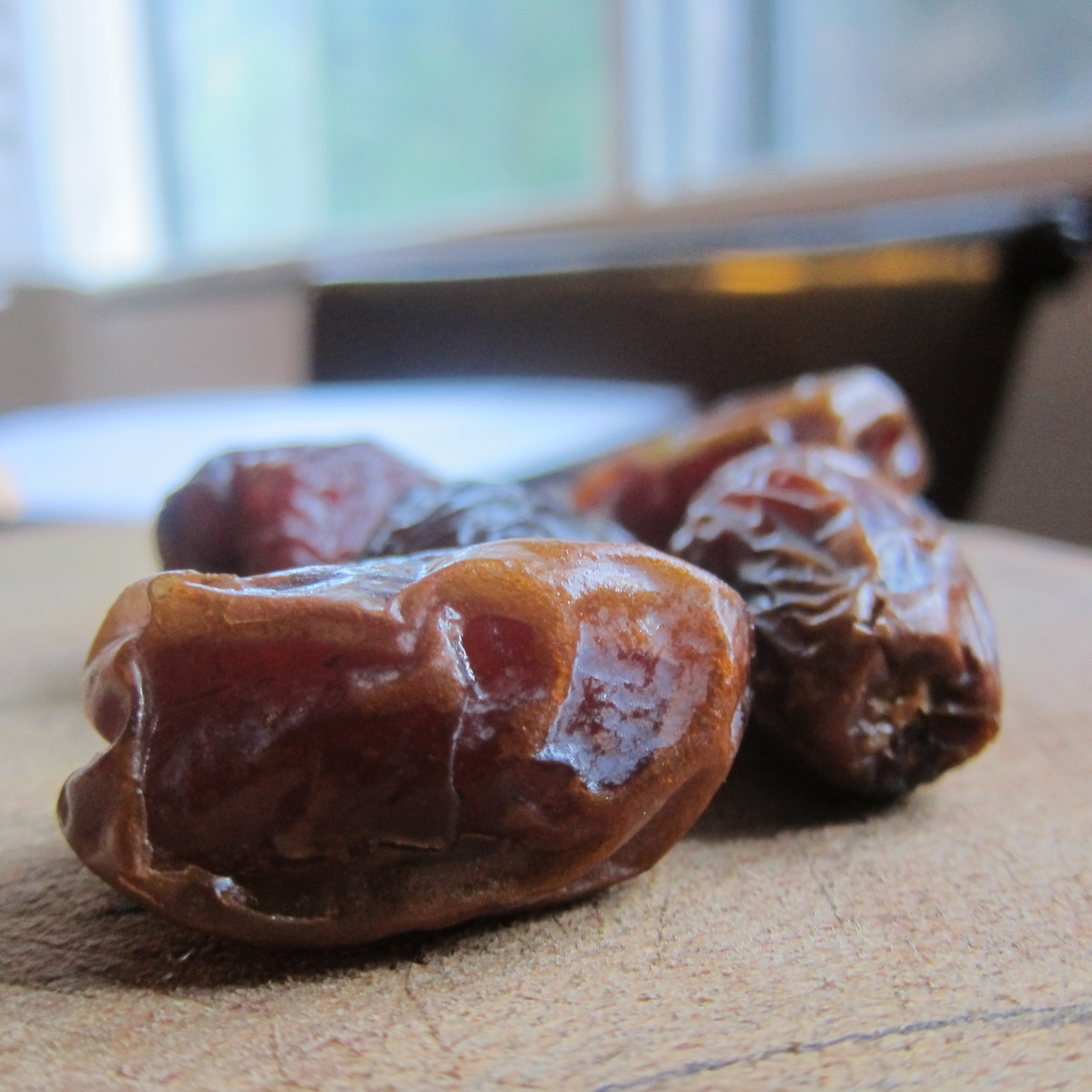
I’ve been on a Medjool date jag for months now. No mean feat if you consider the season is only supposed to run from September to November. Perhaps it’s because they’re grown in Coachella, a mere 132 miles away, that we’re experiencing such a glut. And they store well; six months in the fridge and they’re none the wiser. Medjools, along with Khadrawy, Halawy and Barhi, are classed as ‘soft’ dates because of their high moisture content. I will try to define the texture without straying too far into food-porn territory; your teeth break the sugar-blistered amber skin of the Medjool and the immediate sensation is a densely rich and yielding butterscotch flesh.

Two of these dates are the equivalent in sugar rush to eating a whole Milky Way without the artificially potent high and crashing low. Medjools in particular have a natural affinity with oranges – see the Sticky Toffee Pudding recipe – and dark chocolate. A collection of all three would make a fine dessert plate. Dipping medjools into melted dark chocolate and leaving to harden would also make a fine marriage.

Semi-dried dates, such as Deglet Noor, seem to belong to childhood Christmases; the rounded rectangular box covered in cellophane and decorated with palm trees and camels would always sit alongside a tray of nuts no one could crack. These dates are stickier, tougher and go well with thick yogurt.

But Medjools are the Kardashians of the date world; their demands are such that each date must be hand-pollinated and hand-harvested, while keeping their heads hot and feet wet at all times in order to thrive. This is also why they’re so expensive; cultivation is back-breaking and incredibly complex, with workers having to scale towering date palms several times a day to ensure a satisfactory yield. Talk about high maintenance.

Hot Date Compote (serves 2)

Adapted from Nigel Slater, Real Fast Puddings

1 tbs butter

8 soft dates, stoned and chopped

Generous squeeze of a large orange (about 6 tsp/30ml) and the zest

1 heaped tbs shelled pistachios, roughly chopped

Melt the butter in a pan until just starting to brown and smell nutty. Add the dates and let them soften over a gentle heat, giving the pan a good shake every now and then. Toss in the pistachios and let them brown slightly. Now deglaze the pan with the orange juice; this will pick up all the sticky, chewy bits that have started to caramelize. Add the zest, and let it all bubble for a minute or so, until it begins to look and feel like a puree. Serve hot over Greek-style yogurt or with a ripe, juicy pear. This compote is also amazingly good with pork as well as with a blue cheese such as Stilton or Roquefort (but not for breakfast – this would be stretching it even for me).

Share this:

  • Share on X (Opens in new window) X
  • Share on Pinterest (Opens in new window) Pinterest
  • Share on Facebook (Opens in new window) Facebook
  • More
  • Share on Reddit (Opens in new window) Reddit
  • Share on LinkedIn (Opens in new window) LinkedIn
  • Share on Tumblr (Opens in new window) Tumblr
  • Print (Opens in new window) Print
  • Email a link to a friend (Opens in new window) Email
Like Loading...

Cocoa and Earl Grey Shortbread

14 Tuesday Feb 2012

Posted by Sophie James in Recipe

≈ Leave a comment

Tags

Baking, Food, Ingredients, Italy, Recipes, Stories

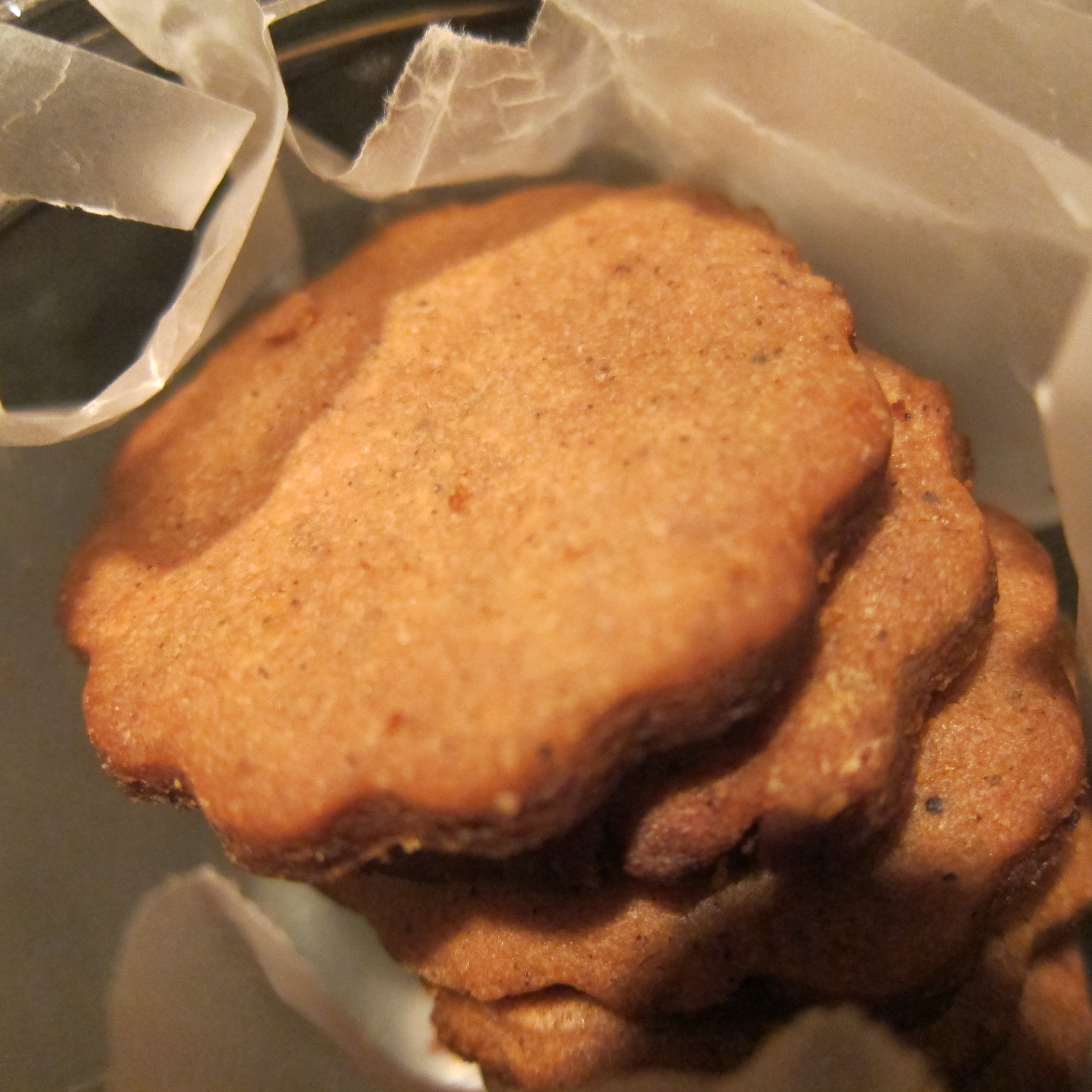
I know for many of us shortbread isn’t exactly a breakfast item, but one of my over-riding memories of living in Rome was seeing my landlady every morning scoffing biscotti and knocking back an espresso topped up with lukewarm tap water. Quite pragmatic really. I also think we may be in danger of taking the whole healthy eating crusade too far, and we live in LA where this is endemic. As long as you are instrumental in creating the food you will eat, you cook the food you love, you know what’s gone into it and hopefully where it’s come from, the rest is just common sense.

These have a lightness about them; I’d say ethereal but that would be going a bit far. The egg yolks and butter keep things crumbly and short rather than cakey, which I’m not a huge fan of. This is probably because I’ve never mastered the hallowed chocolate chip cookie, which takes that subtle interplay of cookie and cake to its ultimate conclusion.

Cocoa and Earl Grey Shortbread

Adapted from Cindy Mushet, The Art and Soul of Baking

Makes about 24 (if using a 6cm round cookie cutter)

12 tbs (175g) butter, softened

Scant 1/2 cup (90g) organic cane sugar

Generous pinch of sea salt

2 medium egg yolks (organic and free range)

Grated zest of a whole orange or lemon

1 heaped tbs Earl Grey tea leaves

2 heaped tbs organic cocoa powder (Green and Blacks is good)

Scant 1 1/2 cup (200g) of plain flour (plus extra for dusting)

Whizz together the sugar and Earl Grey tea in a coffee grinder or spice mill until the tea leaves are very fine. Now beat this together with the butter until the mixture is light and fluffy. This can take a good 5 minutes but it’s important to get the right consistency. Add the salt, egg yolks and zest. Beat for half a minute. Sift together the flour and cocoa powder and gently fold it into the butter, sugar and egg mixture using a spatula until the mixture coheres. The dough will be very sticky. With floured hands place the dough on to a floured surface and pat into a wide, flat disc. Wrap in plastic wrap and refrigerate for half an hour.  Preheat the oven to 350F. Roll out the dough onto a floured surface to a thickness of about 3mm. You may need to refrigerate again for short while after this bit. Use a 6cm cookie cutter – or whatever shape and size you want – to cut out your shortbreads and use a palette knife to transfer them to a non-stick unlined baking sheet and bake until just firm to the touch. 8-10 minutes. Transfer to a wire rack to cool and store on parchment paper in an airtight container. They keep for about a week.

Share this:

  • Share on X (Opens in new window) X
  • Share on Pinterest (Opens in new window) Pinterest
  • Share on Facebook (Opens in new window) Facebook
  • More
  • Share on Reddit (Opens in new window) Reddit
  • Share on LinkedIn (Opens in new window) LinkedIn
  • Share on Tumblr (Opens in new window) Tumblr
  • Print (Opens in new window) Print
  • Email a link to a friend (Opens in new window) Email
Like Loading...

stp, before 10am

13 Monday Feb 2012

Posted by Sophie James in Recipe

≈ Leave a comment

Tags

Baking, Breakfast, Dessert, Food, Fruit, Ingredients, Recipes

image

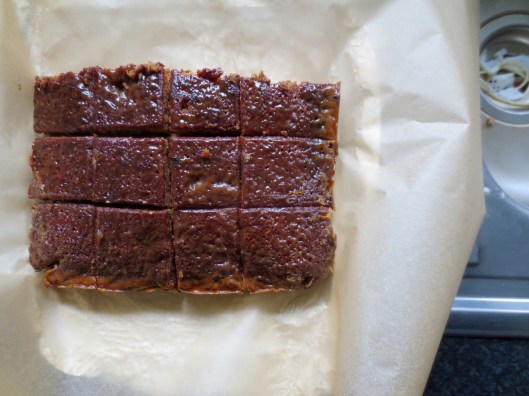
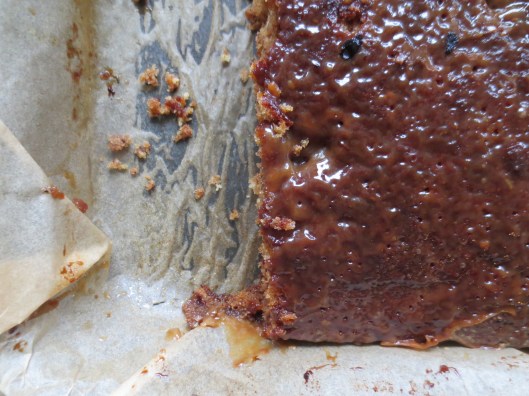
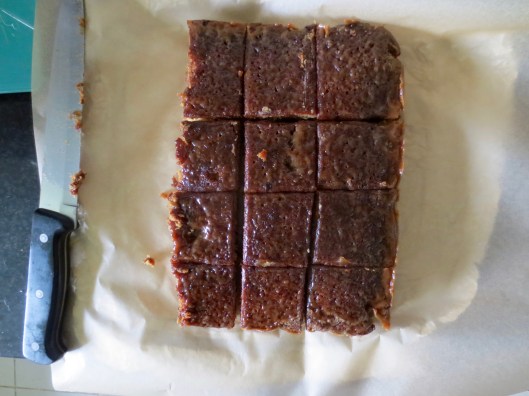
Plump, soft dates lend themselves to warm puddings and, yes, I have served this at breakfast time and got away with it. Given its name, sticky toffee pudding has none of the leaden qualities you would expect, and is actually well suited to the breakfast table; rich but not heavy, and rather muffin-like in texture.

I started off trying to perfect a sticky toffee pudding recipe using Jane Grigson in English Food as my source; Francis Coulson apparently invented it in 1948 at his country house hotel at Sharrow Bay on Ullswater, and it’s been fairly unmessed with ever since. Dates, softened with boiling water and bicarb, are added to a basic cake mixture which is then baked and served slathered in piping hot, toffee sauce.

I couldn’t perfect it; it is already exactly as it should be. All I did was add the juice and zest of an orange because it counteracts the rich effect of the dates and gives it a nice early morning brio. Blood oranges are in season, and their tartness is a good foil for the sweetness, but use whatever is available. Raisins also help keep the cake moist, adding pop and juice.

IMG_0884

I  gave the finished cake a light dousing with the toffee sauce and grilled it as the toasted stickiness reminded me it was intrinsically pudding and messy that way. To be eaten with vanilla ice cream I should think, or yoghurt if before 10am.

Sticky Toffee Pudding

Lightly adapted from Jane Grigson, English Food

I’m not entirely convinced that you need to liquefy the dates with water and bicarb. Or at least I’m not entirely convinced about the bicarb, which if you can taste it even minutely, is revolting and tinny on the tongue. Other recipes advise simply chopping the dates very finely, which I’ve tried and also like. You could perhaps try both. Here I’ve stuck to the original for ease and because it’s still delicious (though have reduced the amount of bicarb).

175g dates, stoned and chopped

1/2 teaspoon bicarbonate of soda

175g caster sugar

60g unsalted butter, softened

2 free range eggs (at room temperature)

175g self-raising flour, sifted

pinch of sea salt

Finely grated zest and juice of 1 blood (or normal) orange

Large handful of raisins (optional)

For the toffee sauce:

140g unsalted butter

200g light muscovado sugar

6 generous tablespoons of double/heavy cream

Pinch of sea salt

Zest of 1 orange

Pre-heat the oven to 180C/350F. Butter a square cake tin approximately 24cm x 24cm.

Make the sauce by putting all the ingredients into a pan. Heat slowly until the butter has melted, then turn up the heat and bring to the boil. Simmer for 3 minutes. Add more salt if you like it salty, as is the current style.

Put the dates and raisins in a saucepan, add 250ml of boiling water and bring to the boil. Remove from the stove, stir in the bicarb and leave to stand.

Beat together the butter and sugar until fluffy, and then gradually beat in the eggs. Fold the flour and salt gently into the batter and add the orange zest. Once the dates and raisins have soaked up all the water, add this to the cake mixture along with about 3 tablespoons of juice from the orange, or a hearty squeeze. Don’t over-mix.

Pour into the cake tin and bake for about 30-35 minutes or until a skewer comes out clean.  Then puncture holes over the top of the cake and pour over half the toffee sauce. Heat the grill to medium, and put the pudding briefly underneath, keeping an eye on it as it can easily burn. Serve with the remaining toffee sauce, along with a dollop of ice cream for dessert (fresh ginger ice cream works beautifully), or as is at any other time.

If you want to store this cake before eating, leave it toffee-free and keep the sauce in the fridge. Then, when it’s close to serving time, poke the cake all over and douse with the sauce, cover the cake in foil, gently re-warm in the oven at 150C/300F for about 20 minutes. Finish off with a blast from the grill.

IMG_0897


Share this:

  • Share on X (Opens in new window) X
  • Share on Pinterest (Opens in new window) Pinterest
  • Share on Facebook (Opens in new window) Facebook
  • More
  • Share on Reddit (Opens in new window) Reddit
  • Share on LinkedIn (Opens in new window) LinkedIn
  • Share on Tumblr (Opens in new window) Tumblr
  • Print (Opens in new window) Print
  • Email a link to a friend (Opens in new window) Email
Like Loading...
← Older posts
Newer posts →

Enter your email address to follow this blog and receive notifications of new posts by email.

Join 2,214 other subscribers

Top Posts & Pages

Fruit tea loaf
Swimmingly
How not to die from marmalade

Recent Posts

  • At my allotment
  • A compendium of sorts
  • Mulberries
  • We are nature
  • Leaving home
  • A treacherous herb
  • Just stop it
  • Why I swim

Great books I’ve read

Blogs/Websites I read

  • Letitia Clark
  • Nigel Slater
  • Room to heal
  • Samantha Harvey
  • Stewart Lee
  • The Kureishi Chronicles
  • The Marginalian
  • Tom Cox
Follow Stories from the Stove on WordPress.com

Archives

  • June 2023
  • February 2023
  • September 2022
  • August 2022
  • July 2022
  • May 2022
  • February 2022
  • December 2021
  • August 2021
  • April 2021
  • March 2021
  • January 2021
  • June 2020
  • November 2018
  • August 2017
  • July 2017
  • May 2017
  • April 2017
  • February 2017
  • January 2017
  • November 2016
  • May 2016
  • October 2015
  • July 2015
  • June 2015
  • April 2015
  • March 2015
  • January 2015
  • December 2014
  • November 2014
  • October 2014
  • September 2014
  • August 2014
  • July 2014
  • June 2014
  • May 2014
  • April 2014
  • March 2014
  • February 2014
  • January 2014
  • December 2013
  • November 2013
  • October 2013
  • September 2013
  • August 2013
  • July 2013
  • June 2013
  • May 2013
  • April 2013
  • March 2013
  • February 2013
  • January 2013
  • December 2012
  • November 2012
  • October 2012
  • September 2012
  • August 2012
  • July 2012
  • June 2012
  • May 2012
  • April 2012
  • March 2012
  • February 2012
"A WOW piece!" Claudia Roden on Walnut Bread

Walnut bread

Lucas’s chocolate marmalade slump

Tags

Afternoon tea Allotment Almonds Art Autumn Baking Bread Breakfast Cafes Cake Childhood Chocolate Christmas Citrus Claudia Roden Cookbook Cooking Dessert Devon Dinner Elizabeth David England Exmoor Fish Food France Fruit Gardening Gelato Gluten-free Herbs Home Homesickness Honey Ice cream Ices Ingredients Italy Jam Jane Grigson Lemons London Los Angeles Lucas Hollweg Marmalade Meat Mediterranean Meyer lemons Nature Nigel Slater Nonfiction Nuts Onions Patience Gray Poetry Pudding Reading Recipe Recipes Salad Sea Seasons Soup Spain Spices Spring Stone fruit Stories Summer Sussex Travel Vegetables Winter Writing Yoghurt

A WordPress.com Website.

Privacy & Cookies: This site uses cookies. By continuing to use this website, you agree to their use.
To find out more, including how to control cookies, see here: Cookie Policy
  • Subscribe Subscribed
    • Stories from the Stove
    • Join 2,082 other subscribers
    • Already have a WordPress.com account? Log in now.
    • Stories from the Stove
    • Subscribe Subscribed
    • Sign up
    • Log in
    • Report this content
    • View site in Reader
    • Manage subscriptions
    • Collapse this bar
 

Loading Comments...
 

    %d