• Recipe List
  • Sophie

Stories from the Stove

Stories from the Stove

Category Archives: Recipe

Chop, chop

25 Tuesday Feb 2014

Posted by Sophie James in Recipe, Uncategorized

≈ 20 Comments

Tags

Food, Ingredients, Kitchen, London, Shops, Stories, Theatre, Utensils

IMG_3392

David Mellor’s shop lives at No.4 Sloane Square in London, yards from the Royal Court Theatre. I would at this point in my life far rather go into a kitchen shop and buy a chopping board than go and see a play, or indeed audition for one. In fact, I steer well clear, scared of bumping into someone from my former life, the theatre bar at the Royal Court witness to a handful of deeply felt humiliations. A theatre bar is not in and of itself a relaxing place to be anyway; everyone is subtly networking or nervous for a friend or relative about to perform (or jealous), everyone is sweeping the room, status – yours and theirs – is being constantly, silently re-negotiated.

You can’t just go up to someone. Which is what I used to do before I realized it was not done. There’s Tom Stoppard! Why, he gave me a small but not insignificant cheque at the beginning of my drama school career. I shall go over and thank him in person. Why not? He looked through me. And then he carried on smoking.

I never developed the right persona – some people do and it’s like armour, I suppose. I know them – charming, robust, flirtatious when needed, personal and then oddly impersonal. After my theatre bar exchanges, after auditions, and meetings, I always felt as if I’d just emerged from a car crash. Or a beheading.

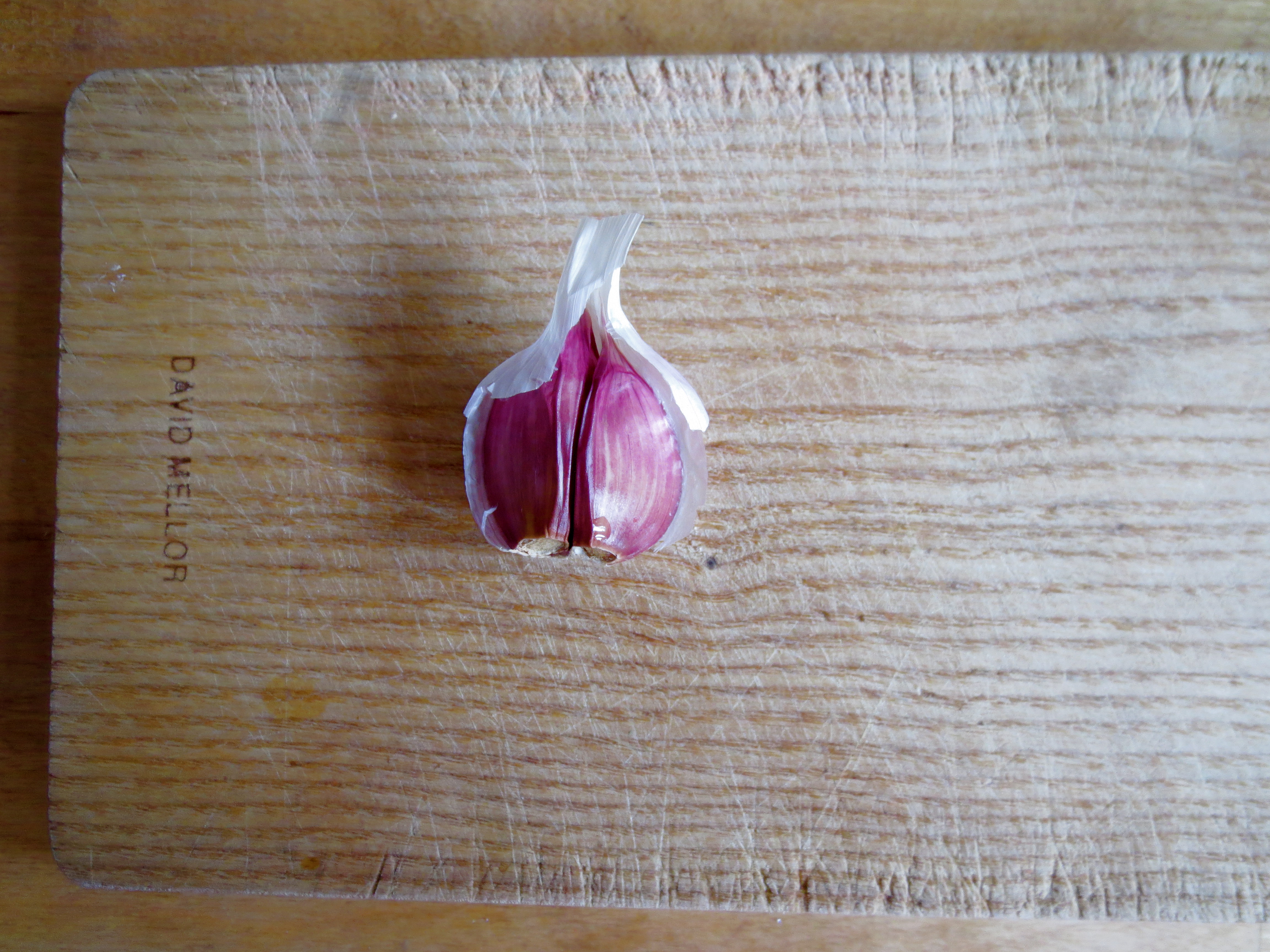
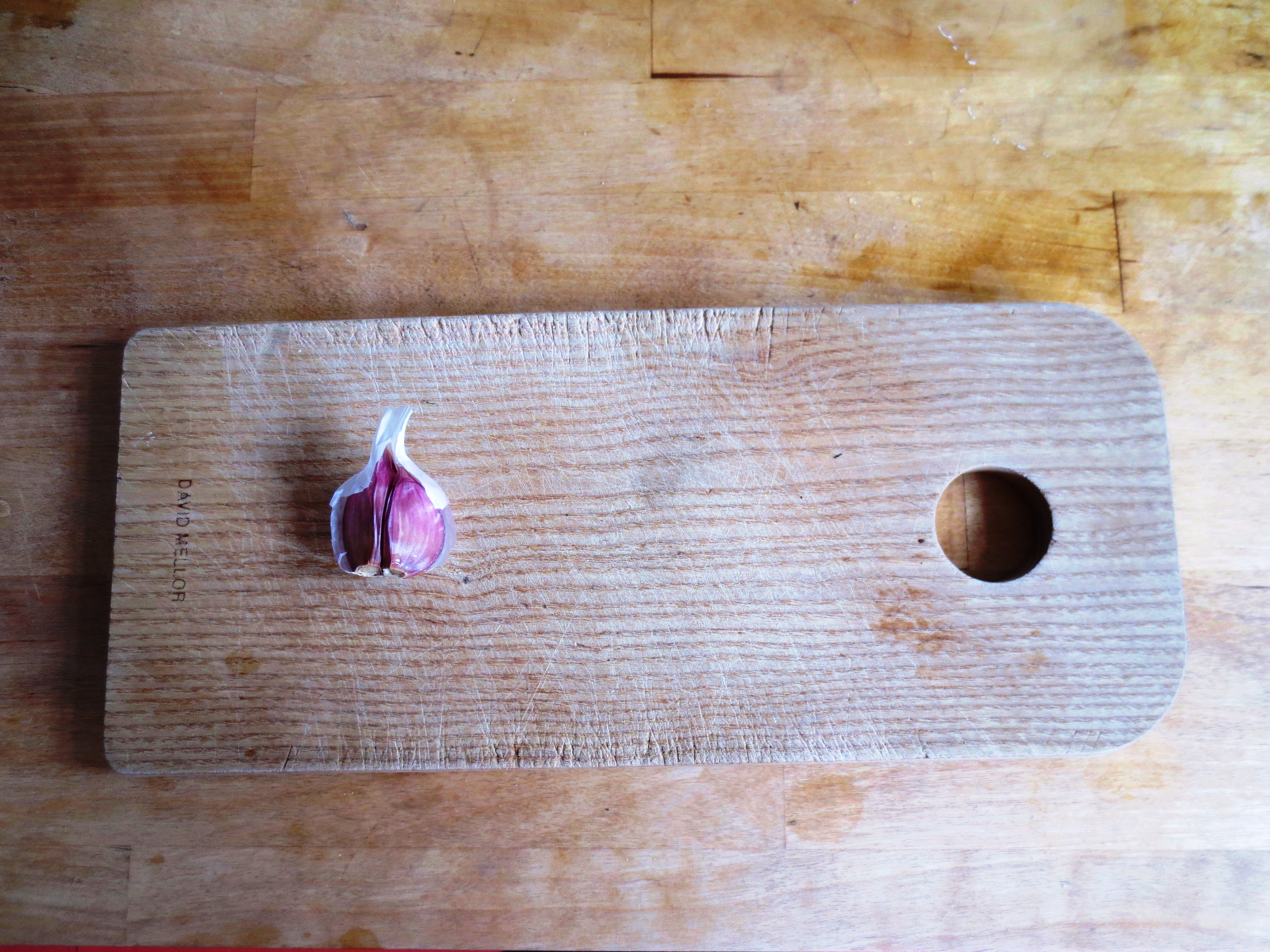
I think that’s when I started going into kitchen shops and reading cookbooks; the balm at the end of a day of commercial castings, speaking my name and my agent’s into a camera before pretending to have road rage or candida (sometimes both). At David Mellor’s I headed straight for the chopping boards, past the sparkling glasses and his signature cutlery. And there it was; the smooth, rounded rectangular board with the hole in it. I had been admiring it at my cousin’s. New it was planed smooth of any imperfections, a plain, pale ash wood, but I knew what it would become with time.

I have always had a thing about chopping boards – I notice them in the same way people notice shoes or jewellery. A chopping board is a living thing and the more it lives with you the more it absorbs all the things you chop on it. I love the way Becky’s board has those little serrations all round the edge, which makes me wonder what they were for and why the centre is relatively empty.
001

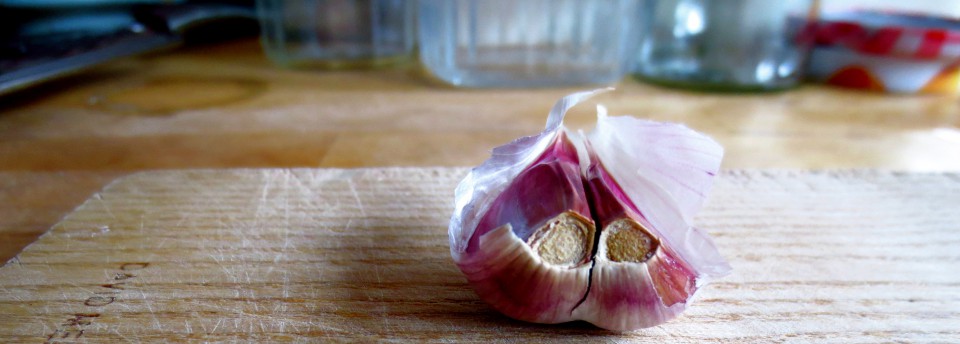
I suppose you could call it a character study. Though I like a bit of pummelling and pounding – the vivifying effects of a pestle and mortar –  there’s something to be said for smashing something, breaking it, or chopping it, or creaming it with a knife. You know the way that garlic can be chopped into a paste, the knife swishing this way and that like a paintbrush until the garlic is practically emollient: I like that.

So I bought the chopping board, and the beautiful, slightly MI5 assistant wrapped it in white paper and slipped it into a black paper bag, and we emerged into the Sunday sunlight and walked to the Tate. All the way there and all the way back, (and during) I thought about the board; what I would anoint it with. Garlic. Lemon zest. Parsley or basil. Splat, Chop, chop, scrape, crunch, chop, chop, chop, chop, swipe, swipe, bang. Smile. Repeat to fade.
004

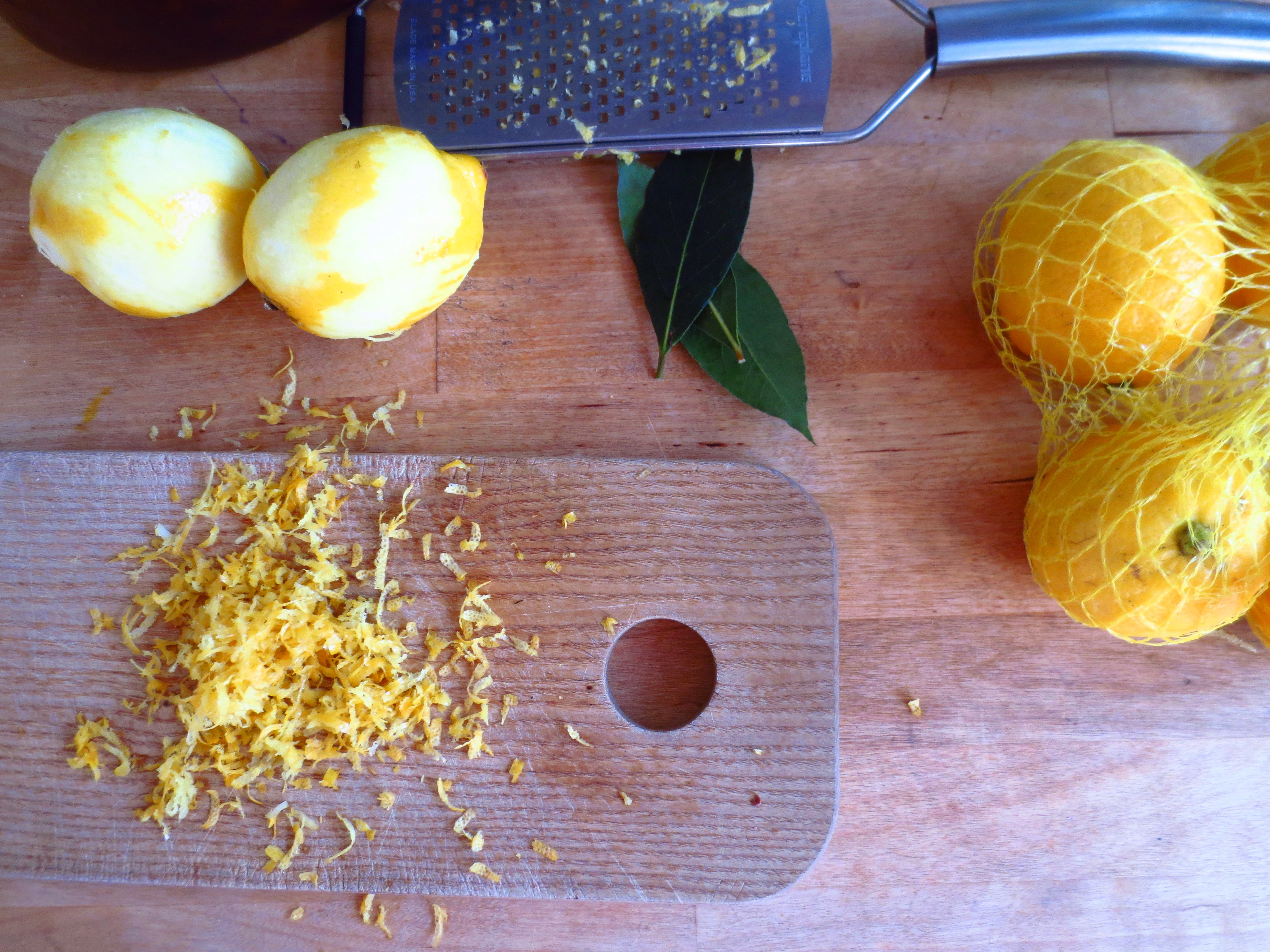
You can make a pesto (basil, garlic, pine nuts, parmesan) or a picada  (Catalan version with parsley and almonds) or a pistou (Provencal version using garlic, basil and oil) on a chopping board, as long as you transfer everything to a bowl before adding the oil (though olive oil is the perfect way to replenish your board – rub it in with a soft, lint-free rag if you have any spillage). Gremolata is a ‘dry’ sauce usually served with osso buco (braised veal shank) and uses garlic and parsley and lots of lemon zest. Try two large handfuls of parsley, the zest of two lemons and two cloves of garlic, reducing them all to a thick slurry. The board, the kitchen, your hands and you will smell intensely of these things afterwards.

More on David Mellor here.
Share this:

  • Share on X (Opens in new window) X
  • Share on Pinterest (Opens in new window) Pinterest
  • Share on Facebook (Opens in new window) Facebook
  • More
  • Share on Reddit (Opens in new window) Reddit
  • Share on LinkedIn (Opens in new window) LinkedIn
  • Share on Tumblr (Opens in new window) Tumblr
  • Print (Opens in new window) Print
  • Email a link to a friend (Opens in new window) Email
Like Loading...

Empty legs

20 Thursday Feb 2014

Posted by Sophie James in Recipe

≈ 10 Comments

Tags

Almonds, Baking, Food, Jane Grigson, Lemons, London, Los Angeles, Stories

010

I had my first shiatsu session the other day (along the same lines as acupuncture but using physical pressure instead of needles), and the man told me I had ’empty legs’. I had empty legs and empty feet, particularly my arches. This is nothing new – when I was a drama school student, the teachers’ main beef with me was that I had ‘dead legs and frozen eyes’. Someone else was described as having ‘no back’. It’s something to do with parts of our bodies being absent to us. The answer these days is to swim more, but I have not ventured into the English Channel since November and certainly don’t intend to now, with the huge brown swell, the sudden big lurching tide that would vanish me in a second. All I do is look at it from the balcony; a passenger on a boat that never docks.

But I know what he means about swimming. In LA I swam every day in an open-air pool. The area was fringed with merry red Bougainvillea, insubstantial as paper and smelling of nothing. My wet footsteps evaporated behind me making me handily invisible. It was all man-made and relatively new; units instead of flats, everything built for the purpose, everything clean. At first glance there is nowhere to hide, no nooks or crannies so you are exposed to the neighbours wanting to chat/complain about the perfect temperature of the water, the ‘chill’ in the air when there is none, the only thing fluttering being the leaf of a book or a butterfly. It feels an empty landscape.

007

Until you take yourself off; behind the tennis court is a narrow pathway where there is a pendulous lemon tree; Eureka lemons that are thick and pock-marked and heavy in the hand and need a hoe to get a purchase. Sprouting like mad hair is wild fennel and the smell is strong and medicinal and follows you to the orange trees, their diseased leaves and strongly floral blossoms heady like some kind of deathly elixir. A wild peach tree stands anonymously with blossoms like any other and tough herbs lead the way round the complex. Yards from the pool is this alchemy of smell coming up from the dust.

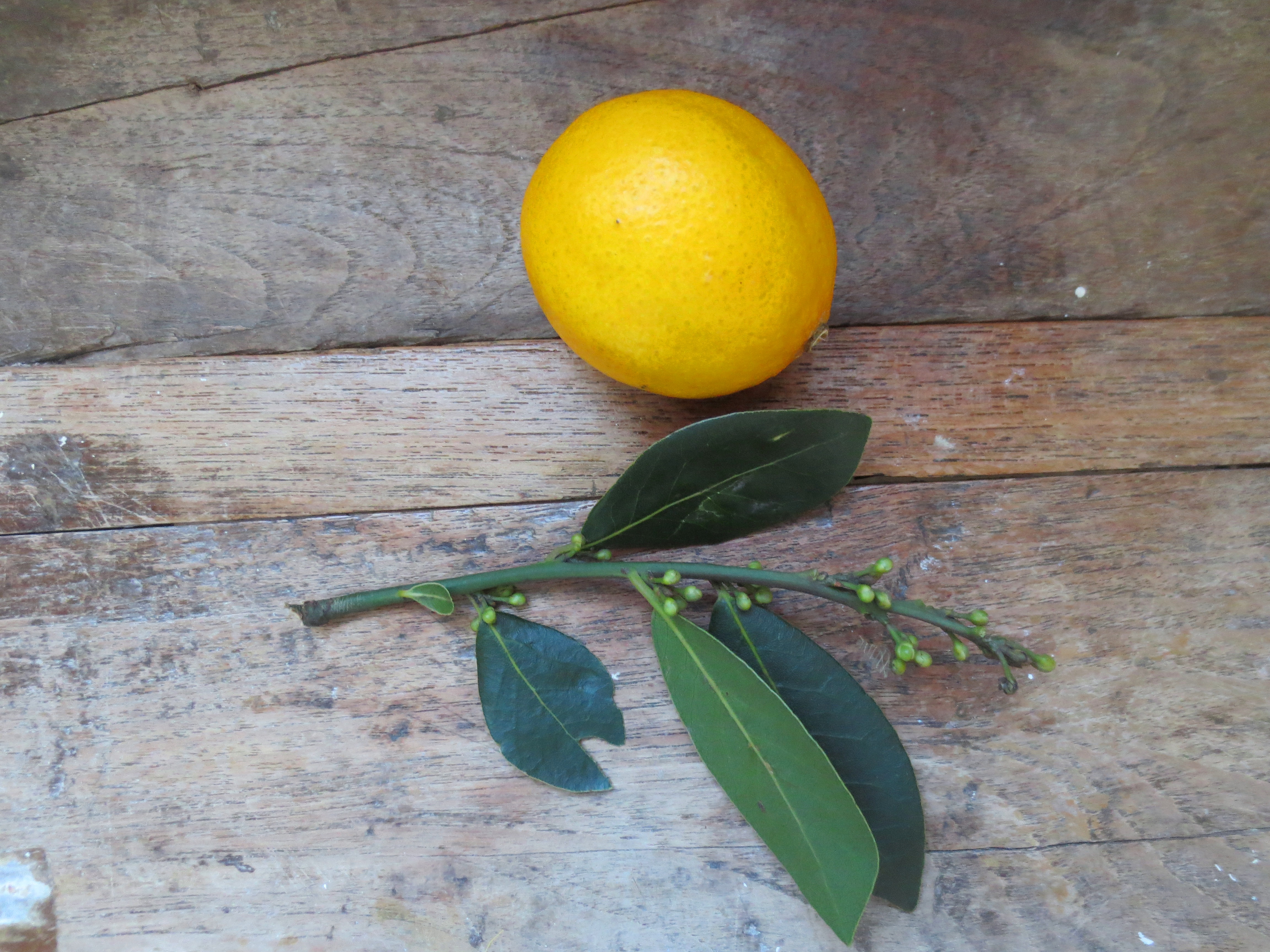
For me the pull to this landscape is stronger, particularly now that I know about our own Meyer lemon tree and its rash of blossom and the ‘eight or nine’ hummingbirds that visit it every day. And Joe is there doing the B&B in my stead, greeting the guests, not making the lemon shortbread or jam or ironing the sheets (‘I’m not going to do it like you’), but feeding the stray cat and getting rave reviews and being lovely as only he can be. Here in England there is rhubarb and snowdrops and long cold doused days and the obscene trickle of rainwater as it finds the nape of the neck. Bay trees stand to attention outside glossy eateries but it rarely occurs to me to take a leaf and scrunch it up, and smell its warm spiky clove-ness.

Occasionally it feels like fun; the new roomy Circle Line and the hoards of children on half term holiday on the tubes and the buses up in London (‘hold on to the yellow, Imogen!’). A small boy in a bike helmet traces his F Words To Work On next to me with his finger: frightened, fallow, fall, fat. And suddenly I feel bereft that there’ll be no Imogen in LA, none of these terribly English moments. So I make myself think of the sun, like a huge melting pat of butter in the sky. The blue will be the most unEnglish blue. The herbs will be virulent, wild and prolific and the air will smell of them. I’ll stride out, lunge into water and then feel it evaporate on my skin. I’ll have my own bowl of lemons, the car, the pool, that constant sun again (always the same), a brilliant dry cleaner, empty streets. Hopefully no more empty legs.

005

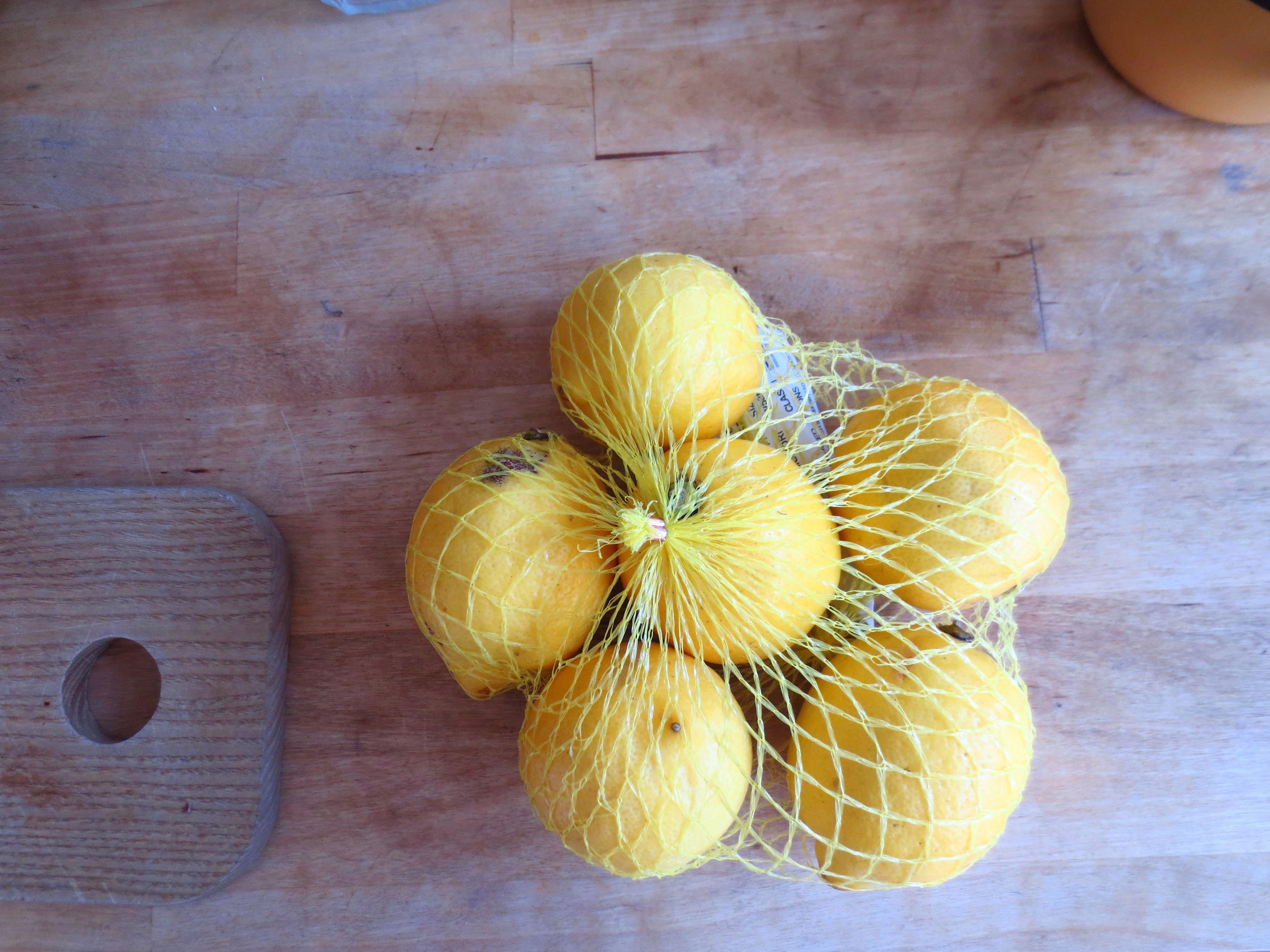
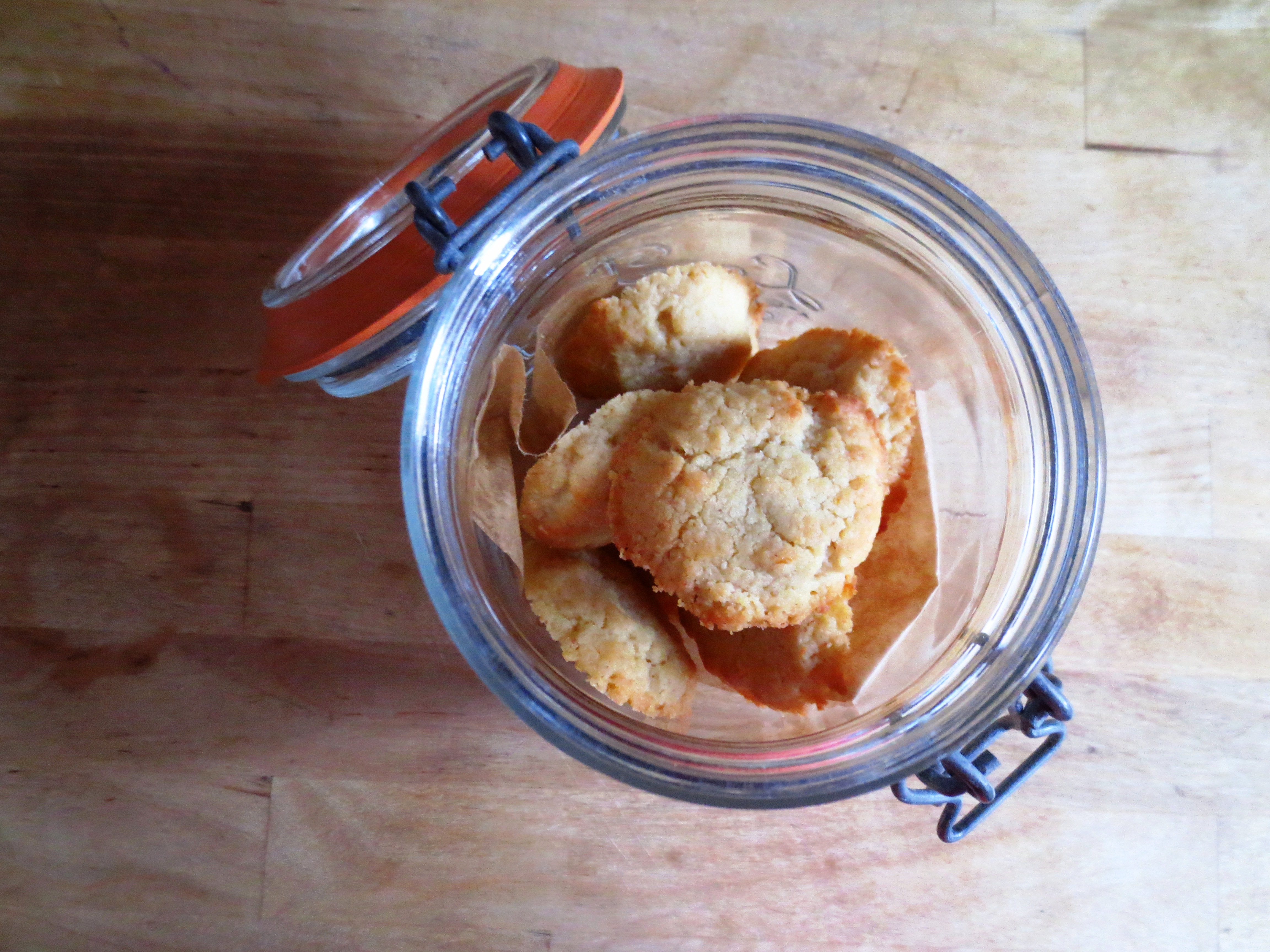
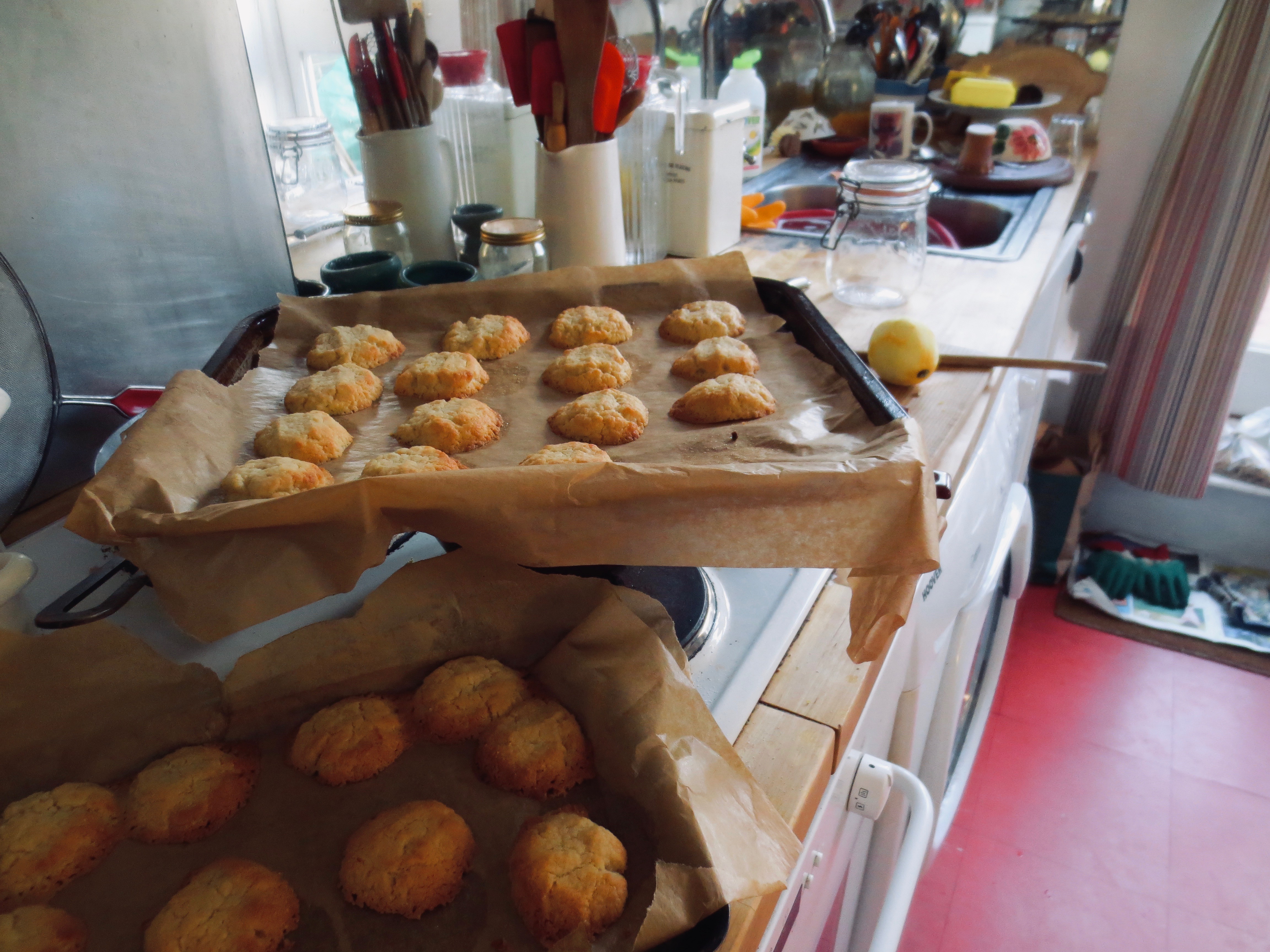
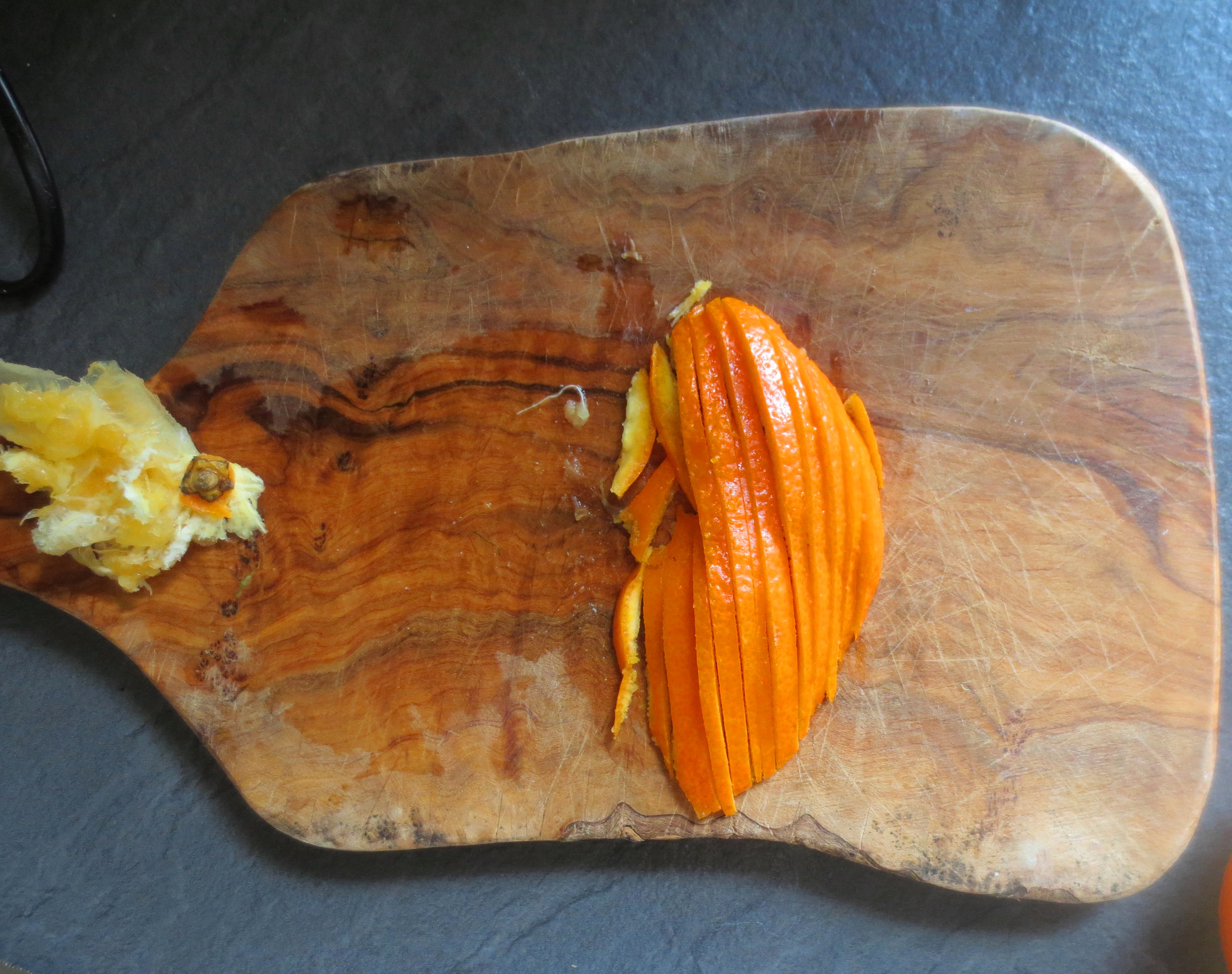
The B&B lemon shortbread began life as Jane Grigson’s shortbread knobs in her Fruit Book though I have doctored them with lemon zest and almonds. They are incredibly simple to make: melt 175g unsalted butter over a medium heat and add the finely grated zest of two lemons. Allow this to infuse and cool. Then add to the butter 200g of plain flour, 25g of ground almonds, 125g of sugar and a pinch of sea salt (all mixed together beforehand in a bowl). Make a sandy paste and then roll the mixture into little teaspoon-sized balls which you then press slightly to flatten. Bake on trays with parchment paper at 150C/300F for about 25 minutes. They’re done when they’re golden brown. Sometimes I drop a couple of torn bay leaves into the melted butter to infuse – is this wrong? I don’t know but I like the smell and fish them out before adding the flour.

Share this:

  • Share on X (Opens in new window) X
  • Share on Pinterest (Opens in new window) Pinterest
  • Share on Facebook (Opens in new window) Facebook
  • More
  • Share on Reddit (Opens in new window) Reddit
  • Share on LinkedIn (Opens in new window) LinkedIn
  • Share on Tumblr (Opens in new window) Tumblr
  • Print (Opens in new window) Print
  • Email a link to a friend (Opens in new window) Email
Like Loading...

Unbearably smug

06 Thursday Feb 2014

Posted by Sophie James in Recipe

≈ 16 Comments

Tags

Breakfast, Citrus, England, Ingredients, Marmalade, Recipes, Stories

027

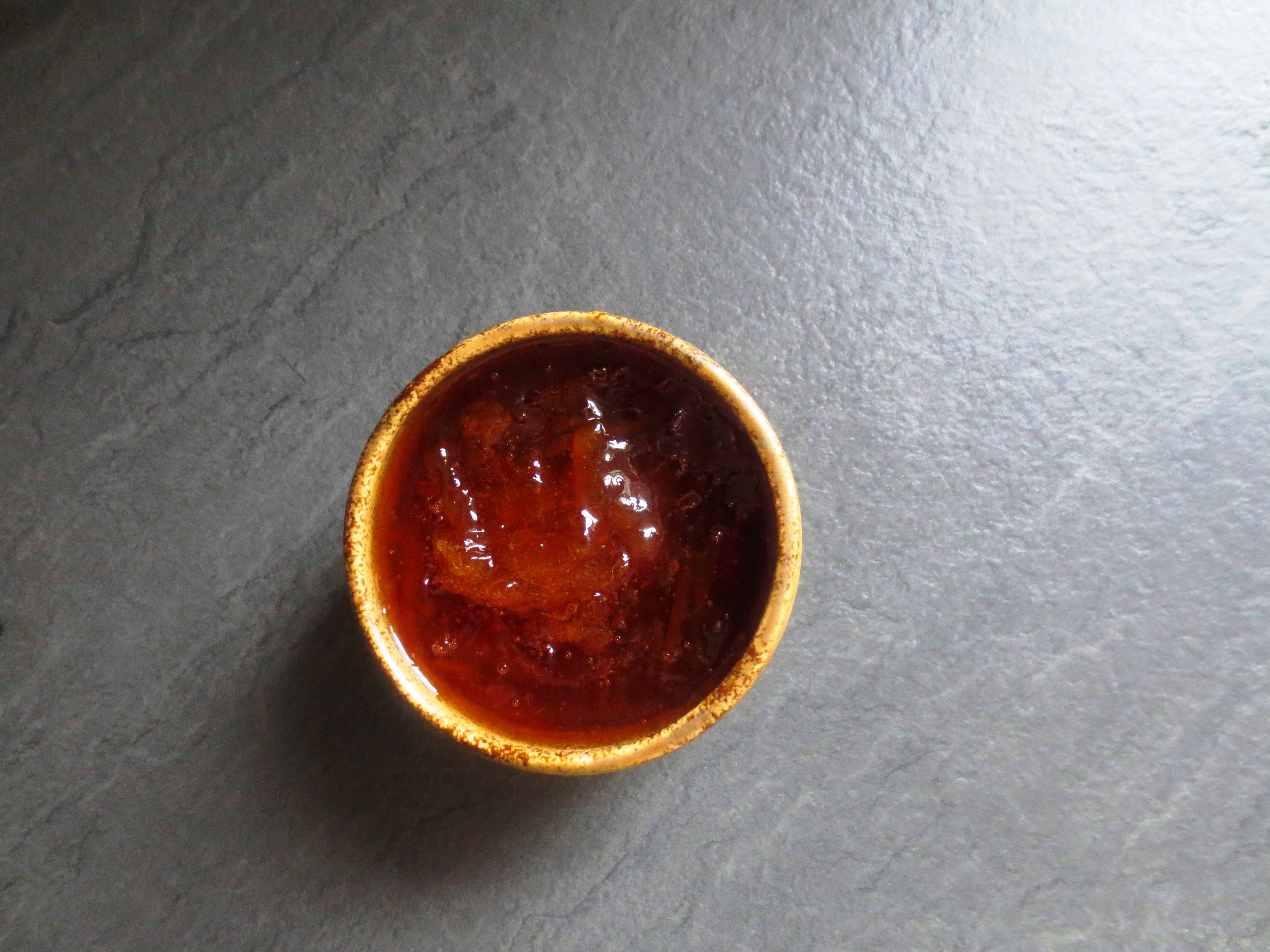
The last of the Sevilles and I barely registered their presence. Here and gone and not really that baggy or grim-looking. Not ugly enough. Normally I’m halted by the sheer filth. But these were tight little things; tidy orange globes with a few grimy seams. All a bit middle class. Still, I couldn’t resist. Because when all else fails, you’ve got a kitchen smelling like an orange grove for twenty-four hours. And then potted up, you’ve got jars of warm pellucid brightness: Seville orange marmalade. And then you can spend the rest of the year being unbearably smug, perhaps handing jars out to people (‘it’s probably awful, yes, I made it, not sure what it tastes like, I didn’t bother measuring, oh god I never buy pectin, it’s all in the pips and pith!’). We are a violently humble people.

And we don’t do it like the French, who on the whole have far more sex than we do. My French friend Monique literally throws beetroot at me in the street. There is no preamble at all. And because it’s straight from her allotment, there is a fair amount of clag attached. She unearths atrocious-looking, gorgeous-tasting stuff and shares it with a bewildered, Gallic shrug, as if to say: what am I going to do with all this incessant greenery?

There are no strings attached to her generosity. And because English is not her first language, there is no hidden meaning in her conversation. There are no barbs or subtle slights. No crowing. We are great crowers. And because I have been here a fair while this time round, I have noticed this as one notices the way ivy creeps into brickwork and destabilizes it. You are demolished slowly, gently, by stealth.

014

The clue is no questions. No interest in who you are or what you’re doing, as if your being interesting is somehow a threat. It must be something to do with being islanders, being victors and colonizers. We are guilty and proud and a bit defensive at the same time. All of this is in the marmalade, by the way: that bitter candy and burnt orange aroma, taut, thick rind against umber jelly, the sticky tributaries of syrup, the brightness in winter, the selfless preserving, the putting up, and putting up with, the sex (or lack thereof). We put it all in there. Possibly why Seville orange marmalade is such a complex preserve; because we are.

001

Seville Orange Marmalade

Adapted from Delia Smith, Complete Cookery Course

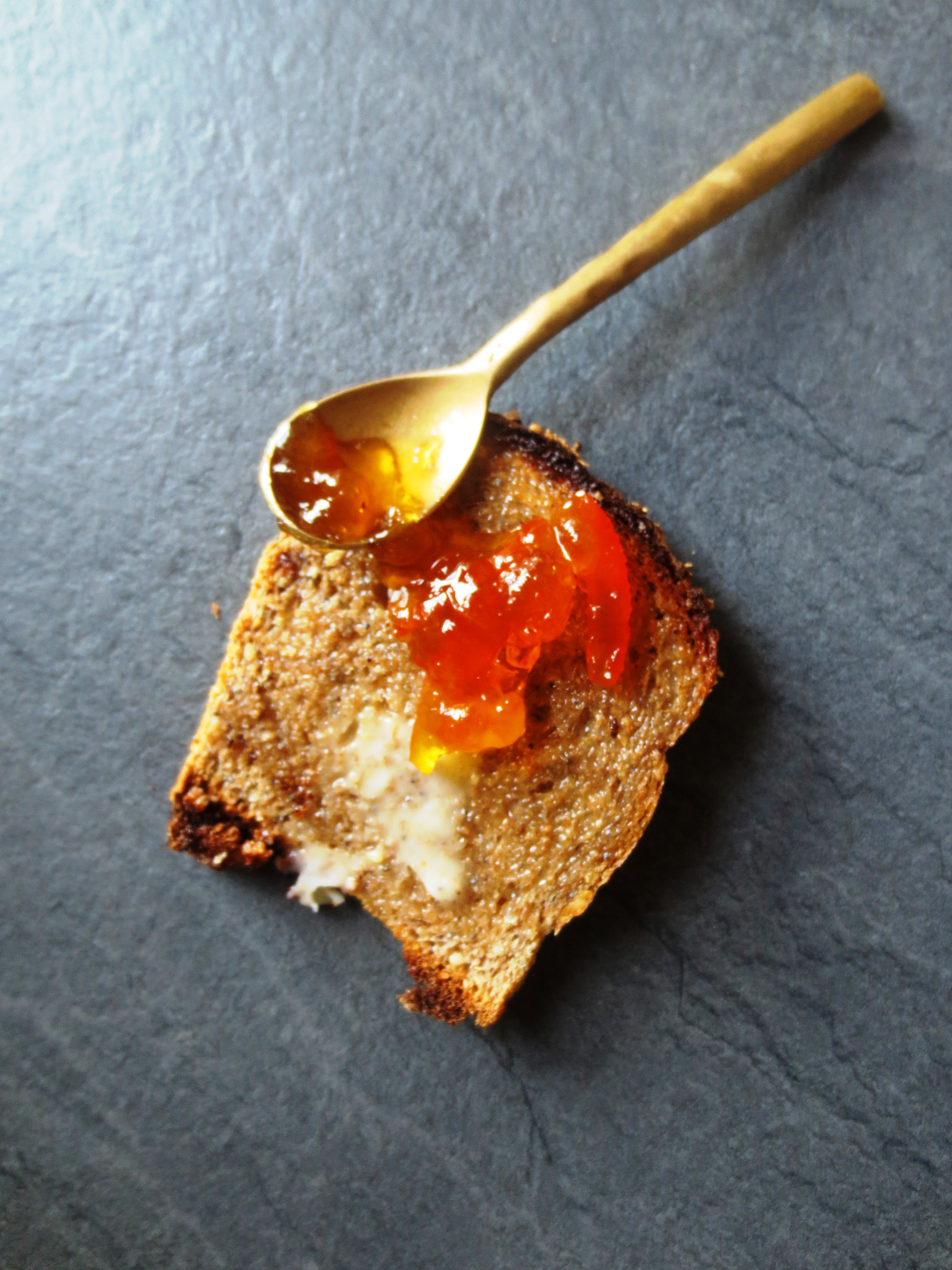
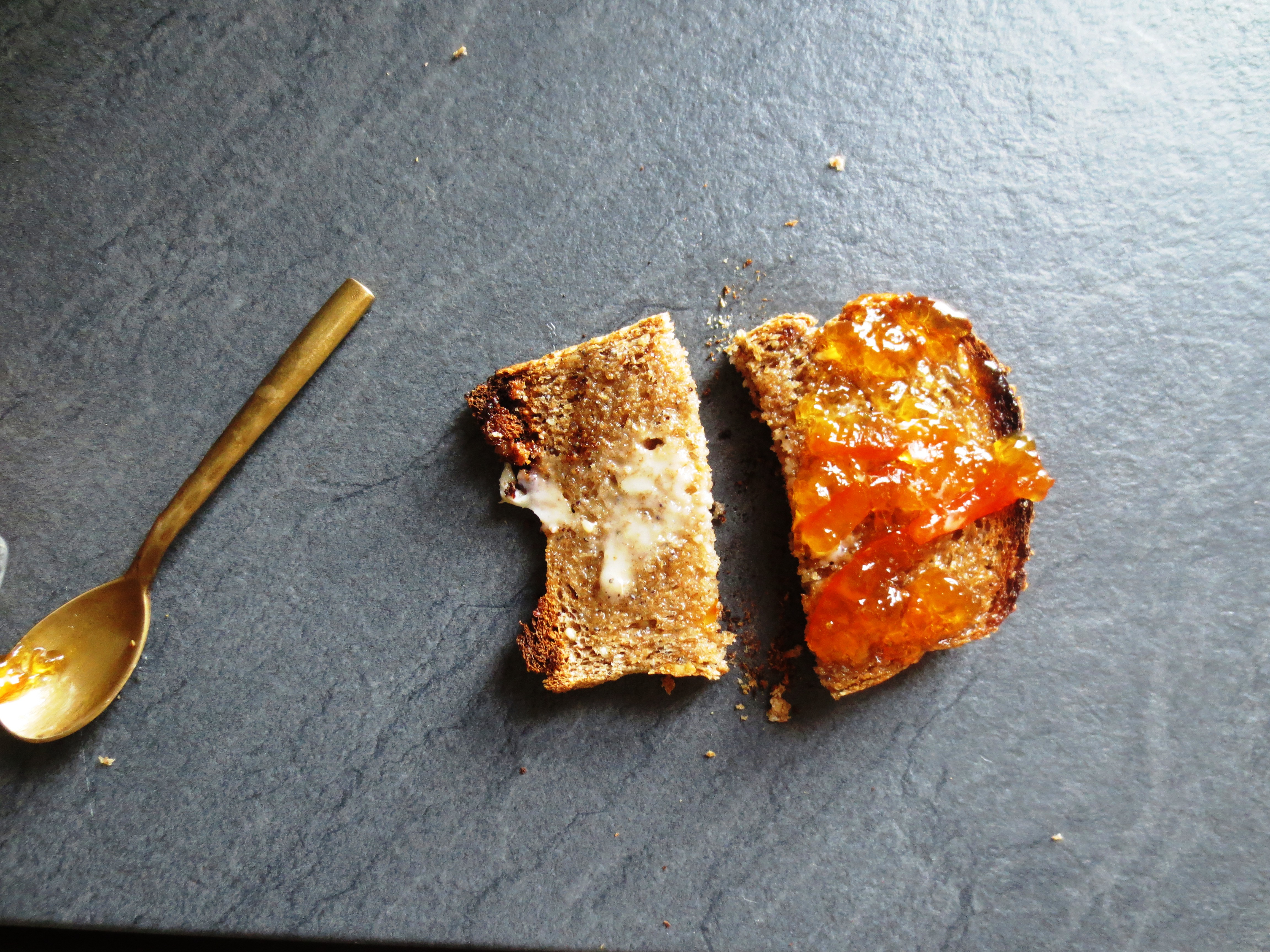
There are versions of this elsewhere on the blog – I would say this is the definitive Delia, and my favourite so far. It’s lovely on its own on a piece of toast, an oatcake, anything, or dropped into some cake batter (gingerbread is a natural bedfellow as is anything chocolate). And in case you are put off by the intricacies of making your own marmalade, just so you know there are no intricacies: I have been making very good marmalade for years with nothing but a big saucepan and a clean handkerchief (for the pips and pith). It’s a bit long-winded, that’s all. Always worth it.

2lb (900g) Seville oranges
1 lemon
4 pints (2.25 litres) water
4lb (1.8kg) granulated sugar (you could make some of this light muscovado)

Six 1lb (450g) jars, a square of gauze/muslin or a clean handkerchief or a new pair of tan tights/stockings, string and a saucer.

Begin by squeezing the juice from the oranges and the lemon into the pan you’ll be using. Remove all the pith and pips as you go and place them on a square of muslin laid over a bowl; the pips and pith contain the pectin which will enable your marmalade to set. Now cut the peel into shreds and add it to the juice – as fine or as thick as you like, but the thicker it is, the longer it will take to soften. When you’re done, add the water to the juice and peel, tie up the muslin to form a small bag – make sure nothing will escape – and add that too. Leave in a cool place overnight.

The next day, tie the muslin bag to the handle so that it bobs like a cork in the liquid  (but doesn’t touch the bottom). Now is the time to put a saucer in the freezer so you can begin testing later. Bring the liquid gently to the boil and then lower the heat and simmer. It is ready when the peel is completely soft – you can test a piece by pressing it between your finger and thumb. This can take anything from 35 minutes to an hour and a half; be aware that once sugar meets rind, it will no longer soften.

When the peel is ready, lift out the muslin bag and leave it on a plate until it’s cool enough to handle. Pour the sugar into the pan and stir over a very low heat until it has dissolved. You may want to hold back on the full amount of sugar and go for a slightly tarter taste. When there are no crystals left, increase the heat and bring the marmalade to a rolling boil. Now squeeze every last bit of the jelly-like pectin that oozes from the muslin bag into the pan. Every little helps here, so be vigilant. Skim off any froth or scum that comes to the surface and leave the marmalade at a fast boil for 15 minutes. Now put a tablespoon of it on one of the cold saucers and let it cool in the fridge. If when you push the marmalade with your finger the mixture crinkles like a furrowed brow, then you have a ‘set’.

Keep testing at 10 minute intervals until it has reached setting consistency. The mixture will start to look more amber and treacly – there is a trick here which is to watch as droplets of the marmalade leave a spoon. When it’s ready, there will be one single droplet; one of the myriad ways of knowing it’s set. Leave the marmalade to settle for about 20 minutes otherwise all the peel will float to the top of the jar. Wash and dry your jars and warm them in a moderate oven – this will sterilize them. Ladle the marmalade into the jars and seal immediately. Label when completely cold.

002

Share this:

  • Share on X (Opens in new window) X
  • Share on Pinterest (Opens in new window) Pinterest
  • Share on Facebook (Opens in new window) Facebook
  • More
  • Share on Reddit (Opens in new window) Reddit
  • Share on LinkedIn (Opens in new window) LinkedIn
  • Share on Tumblr (Opens in new window) Tumblr
  • Print (Opens in new window) Print
  • Email a link to a friend (Opens in new window) Email
Like Loading...

Power of two

27 Monday Jan 2014

Posted by Sophie James in Recipe

≈ 22 Comments

Tags

Baking, Biscuits, Chocolate, Food, Hospital, Hugh Fearnley-Whittingstall, Ingredients, Nonfiction, Recipes, Stories, Sussex

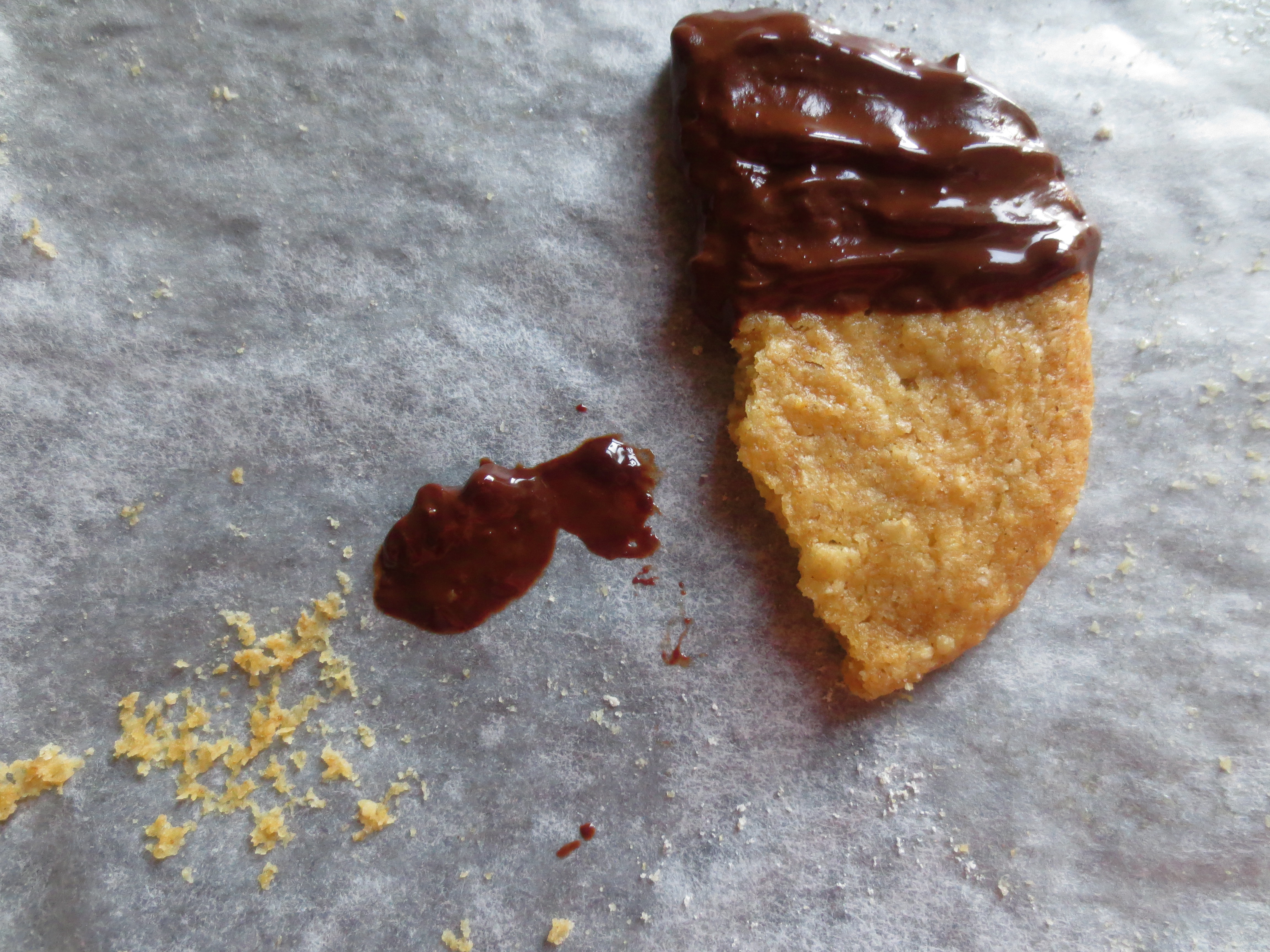
choc

I can’t get excited about root vegetables. Pressure-cooked parsnips and celeriac and the flaccid broths I am now closely acquainted with have started to distance me from their virtues. Yes, warm, inviting, steamy, filling, healthy, earthy, beefy and sustaining etc. Worthy.

If I want something wet and warm it is to be tea; strong, lactic and the colour of a cheap suntan. The cup is important: wide, thin-lipped and bone china, something that warms the hands through. And then there is the all important dunking element: the biscuit. Not cookies, which are too soft and yielding and will flop into the tea and turn it to mush. It must be a digestive. Sandy, burnished brown, the texture of rubble. A slight saltiness. Plain as plain can be. My childhood friend, Tuppy, would layer her digestives with butter and salt, an act I found impressive – she was the first as a child to make the connection between sweet biscuit and salted dairy. Digestives and cheddar are also a winner.

IMG_3110

Digestives are also the fulcrum of the NHS – after a short stay you will be offered a dainty red packet of two and a cup of tea. It gets your blood sugar up, gives you something to gnaw on, brings you back to life. Sitting the other day with the curtain round me in a hospital ward, after a routine though still rather rugged procedure, I ripped open the red wrapper; the two fitted into my palm like medals. I made them last as long as I could.

“Are you alright in there?” the nurse asked, suspicious at my lingering. My answer was muffled with starch and sugar. I couldn’t just have one. “Fine!” I called out. She whipped the curtain back, but I’d already eaten most of the evidence. 24 hours of not eating and nothing can prepare you for the high. Digestives are genius. And she gave me another packet to go home with. She balanced them on a tray and walked beside me like a butler.

My cousin was waiting for me looking normal and smiling with the colour of a windswept sea walk still on her cheeks. I showed her my little red packet and she was impressed. It reminded me in that moment to be grateful – to be there in the first place and to be going home. With her, with digestives.

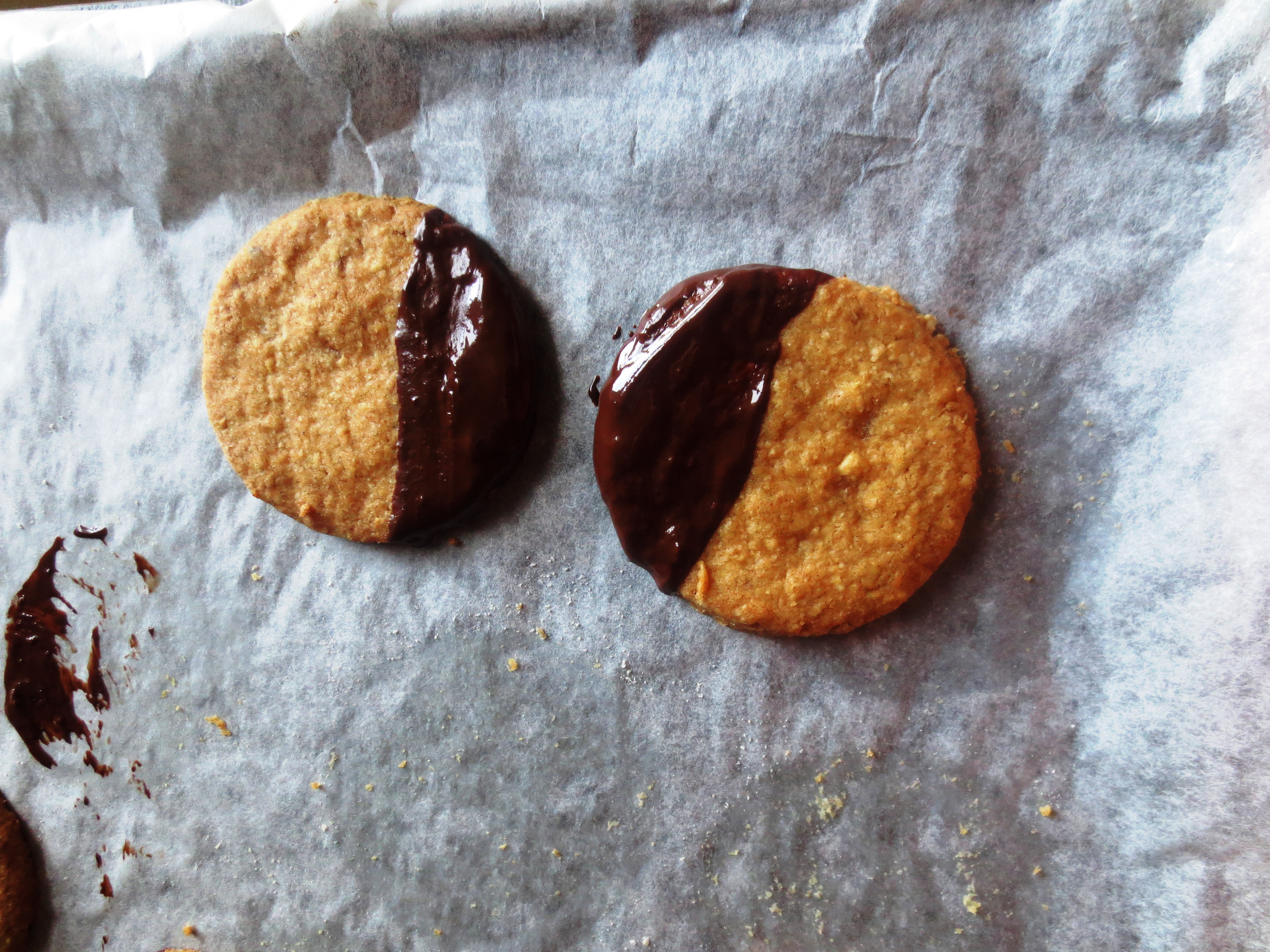
You can dip the digestives – once cooled –  in melted chocolate, and then leave them to harden on non-stick baking paper. Here I used dark chocolate but milk would also work. As you can see, they are not particularly pretty to look at, but very nice to eat, and will enrich your tea dunking activities. The unchocolated ones mimic shop-bought digestives in their sheer plainness. They are also nicely crisp and not overly sweet – you can serve them with cheese or pâté. They are very good eaten on the day but can be stored in an airtight container and enjoyed a few days later.

The term ‘digestive’ was reportedly derived from the belief that the biscuits had antacid properties due to the use of bicarbonate of soda. They were originally made with exclusively ‘brown meal’ – composed of fine bran and white flour. Because brown meal includes the germ, the flour was sweet, and perhaps because of this, digestives have also been called ‘sweetmeal’ biscuits.

Ginger and chocolate digestive biscuits

Adapted from Hugh Fearnley-Whittingstall, The Guardian

No, he’s not paying me. I just happen to like his column. These are based on the classic River Cottage digestive, but made with the addition of ginger and dark chocolate. Both are optional, but if you do go down the ginger route, be generous with the little squares of stem ginger or the flavour and texture can get a bit lost. I used light muscovado here for the soft brown sugar. Makes 20-25.

125g wholemeal spelt flour (or plain wholemeal flour), plus extra to dust
125g medium oatmeal
75g soft brown sugar
½ tsp ground ginger
Big pinch of fine sea salt
1 tsp baking powder
125g cold unsalted butter, cut into small cubes
5 – 6 largish squares of stem ginger, finely chopped
A little milk (I didn’t find this necessary)
200g dark chocolate (or good milk chocolate), broken into small pieces

Heat the oven to 180C/350F/gas mark 4 and line two baking trays with nonstick baking parchment. Put the flour, oatmeal, sugar, ginger, salt and baking powder in a food processor and pulse. Add the butter and pulse again until the mixture resembles fine breadcrumbs. (Alternatively, combine the dry ingredients in a bowl, then rub in the butter with your fingertips.)

Add the stem ginger and, with the processor running, trickle in just enough milk (about 30ml) to bring the mix together into clumps. I didn’t need to add any milk in my batch, my dough was already fairly sticky, but see how you go.

Lightly dust a work surface with flour, tip out the dough and knead gently into a ball. Press into a fat disc, wrap in clingfilm and chill for 30 minutes.

Cut the dough in half. Dust one half with flour and roll it out to 3-4mm thick, dusting regularly with flour to stop it sticking. The dough is slightly sticky and crumbly, so don’t worry if it breaks up a bit; just squash it back together and re-roll. Use a 7.5cm cutter, or a glass or cup, to stamp out biscuits, and transfer these to the baking sheets with a palette knife; re-roll the offcuts to make more. Repeat with the second piece of dough (or chill for use later), then bake for 10 – 12 minutes, until golden brown at the edges and lightly coloured on top.

Remove from the oven and leave the biscuits to cool and firm up on the baking sheets, then transfer them to an airtight container or eat them all.

If you want to: melt the chocolate in a basin over a pan of simmering water. Dip in one half of each biscuit, and leave to set on a silicone mat or a sheet of nonstick baking parchment, before serving.

Share this:

  • Share on X (Opens in new window) X
  • Share on Pinterest (Opens in new window) Pinterest
  • Share on Facebook (Opens in new window) Facebook
  • More
  • Share on Reddit (Opens in new window) Reddit
  • Share on LinkedIn (Opens in new window) LinkedIn
  • Share on Tumblr (Opens in new window) Tumblr
  • Print (Opens in new window) Print
  • Email a link to a friend (Opens in new window) Email
Like Loading...

Greenery & cold blue sky

05 Sunday Jan 2014

Posted by Sophie James in Recipe

≈ 20 Comments

Tags

Christmas, England, Food, Herbs, Ingredients, Recipes, Stories, Travel, Yoghurt

IMG_1335I can’t have any more trifle. Is it me or is everything around this time of year yellow? Cauliflower cheese, the aforementioned trifle with its layers of custard and cream and small pillows of sponge soaked in a harrowing and unnamed alcohol. Potatoes, parsnips, pavlova, wheels of varicosely veined cheese, the sweating clay mantle of marzipan draped over a now moribund Christmas cake (thank you, Alan Partridge, for reviving the word ‘moribund’).
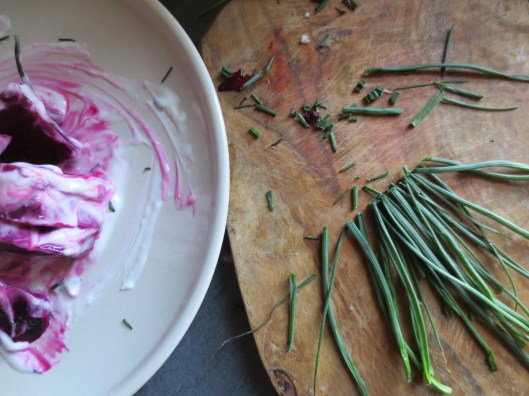
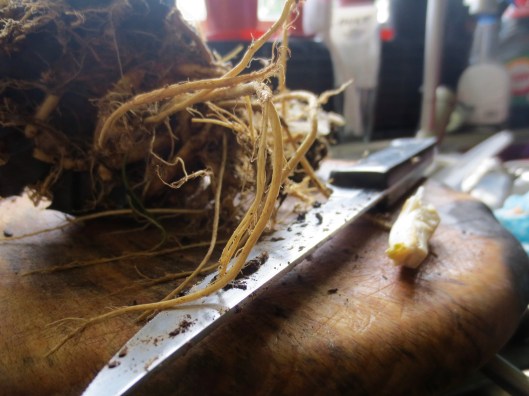
I would kill for something green and empty of any tracklements or gravy. Something, as a young friend said recently, ‘farmier’. So it is in search of the farmy – still showing signs of its former life in a field, a bit on the grubby side – that I am featuring horseradish and chives, and beetroot with the tops still on. Admittedly, horseradish is on the spectrum of yellow, but far from viscous, it is cleansing, almost brutal in its sinus clearing properties.

This has been our first English Christmas for four years. I had forgotten what happens; we have had no one there at all, just echoing voices down the phone and talking heads via Skype, that instrument of torture, all smoke and mirrors. Then, all of a sudden, here we all are, sitting in the same overheated room for five and a half days eating individually wrapped chocolates housing an unfamiliar nut combination. Watching films incessantly, grazing like cattle, and forgetting, consciously, all the people who have nothing, and saying that next year we will volunteer for a homeless charity, to try to counteract the obscenity of all the waste. And then watching another film.

019

But these have been the highlights: travelling across the country afforded us sweeping views; rivers running red with iron in Somerset, an orange-bibbed pheasant launching itself into the air like a kite, faraway hills lush and dramatic with greenery and cold blue skies, and then the lashing rain that pitter-pattered on our skylight windows at night and came down in zig zags during the day. Frosty exteriors and meltingly warm central heating. Watching my dad play in his jazz band in a pub called The Valiant Soldier and meeting by chance a writer I’ve loved reading in The New Yorker, and admiring her shoes (Tessa Hadley).

Dancing with mum in the kitchen, my uncle playing the ukulele. Pretending to be Pina Bausch. Sharing christmas cake recipes; to ice or not to ice? Feeling for the first time in a long time that I am a version of something familiar, not exotic or an anomaly. My accent no longer ‘adorable’. I am no longer adorable! It’s exhausting, and I’m relieved.

Horseradish (below, mine) is a member of the crucifer family, along with radishes, turnips and mustard and looks like a rather disgusting parsnip. Unpeeled it smells of nothing, but once it is nude, it will make you weep copiously. Open a window. It is best treated in the same way that mustard is – it loves roast beef, glazed ham and sausages – really any fatty meats do well. Fatty, oily fish do too. In fact, I have had so many versions of this beetroot-horseradish-fatty fish-or-meat dish in recent months that I may well be verging on the unseasonal.

IMG_1298

Grow your own horseradish with caution; it’s rampant and self-seeds and ‘wants to be’ highly invasive. If you find the root with the leaves still attached you can use them as a salad ingredient, or throw them into a saucepan with a glass of water and boil quickly, treating them as greens, though the leaves of my horseradish are always ravaged and ragged by the time the root is ready and go straight on the compost.

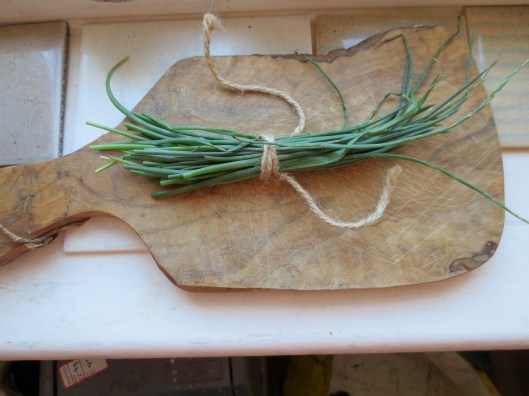
As for chives (Allium schoenoprasum), they add a lovely fresh, oniony grass-like taste – no surprise that they belong to the same family as the onion, leek, garlic and shallot. They have a natural affinity with anything creamy and/or with a nursery blandness such as eggs. Snip them with scissors rather than chop them with a knife. I see them growing ‘wild’ often though I suspect that it may just be a very vigorous, cultivated herb in someone’s abandoned hedge.

Horseradish & chive dressing with roasted beetroot

Adapted from Hugh Fearnley-Whittingstall, The Guardian

About 500g small beets
4 garlic cloves, unpeeled but bashed
1 large sprig fresh thyme (optional)
1 bay leaf (optional)
Sea salt and freshly ground black pepper
A glug of olive oil

For the dressing
200ml thick yoghurt (Greek is good)
Large squeeze of lemon juice & one garlic clove peeled, bashed and chopped
3 heaped tbsp freshly grated horseradish (more if you’ve got a cold)
A small handful of finely chopped chives, plus more to finish

To serve
4 smoked mackerel fillets or scrambled eggs or an omelette
Salt and freshly ground black pepper

Heat the oven to 200C/390F/gas mark 6. Scrub the beets, but leave them whole, then place on a large piece of foil. Scatter with the garlic, thyme leaves, bay leaf and some salt and pepper, then dribble with oil. Scrunch up the foil to make a sealed parcel, place it on a baking tray and put in the oven. Roast until tender – about 45 minutes for small ones. The beetroots are cooked when a knife slips easily into the flesh. Leave to cool, then top and tail them, and remove the skin. Cut into wedges and place in a large bowl.

Whisk together all the dressing ingredients and season. Divide the beetroots between four plates and dollop the horseradish in the vicinity. Scatter on some more chives, season to taste and serve with lemon wedges and/or some scrambled eggs and/or mackerel fillets.

Share this:

  • Share on X (Opens in new window) X
  • Share on Pinterest (Opens in new window) Pinterest
  • Share on Facebook (Opens in new window) Facebook
  • More
  • Share on Reddit (Opens in new window) Reddit
  • Share on LinkedIn (Opens in new window) LinkedIn
  • Share on Tumblr (Opens in new window) Tumblr
  • Print (Opens in new window) Print
  • Email a link to a friend (Opens in new window) Email
Like Loading...

In the street

24 Tuesday Dec 2013

Posted by Sophie James in Recipe

≈ 16 Comments

Tags

Christmas, Citrus, Dessert, Friendship, Fruit, Ingredients, Italy, Nonfiction, Recipes, Stories, Travel

img_0535

That’s how I met her. Running from a broken down train and away from a car crash, in Newhaven of all places. The last time I made a friend this way was twenty years ago in a bakery in Venice, and my accent gave me away. It was heady, to think that’s how it can still be done, meeting in the street and suddenly you’re friends. I ran after her. I wasn’t chasing her or anything, but she just said quickly “follow me” and so I did. It was like being in Borgen.

Her stepfather was waiting for us in a car, and she had to explain quickly who I was and what was going on. I didn’t wait outside because of the freezing wind. I threw myself into the back like a labrador, and we were away. All round the houses, because of the crash. There weren’t even any buses, so if it hadn’t been for her I would have been walking along the English channel for two hours trying to avoid the dog turds. I still feel bad we completely ignored her stepfather. I slipped in a thanks everso much at the end. But it was too exciting, meeting like this. And having so much in common, we even knew people from way back. A cinematographer meeting an actress. Zero degrees of separation.

The last time it felt like no big deal. I met Charlotte in a bakery in Venice, and the next thing I know (and because of her) I’m sitting in Trieste having an interview for a place at Warwick University with the head of the Italian department and his daughter over a bowl of penne alla vodka. I remember the pinky-red sauce and the fumes of subtle alcohol, and the sheer exuberance of the conversation. Actually, he was a monologuer, one of those people who talks in order to stay alive. But in those days, it felt normal, this happenstance. Maybe all young people feel like that – somehow touched by a higher hand. I just wandered into things and it all came out alright. 


This is a bit of a cheat. But it gives everyone a breather from all the stolid mince pies and Christmas pudding, and the sheer load of food consumed on the day. It twinkles and it’s orange. And it’s a chance to show off your extravagance in buying in some marrons glacés (candied chestnuts) which are bloody expensive so just one each (and completely unphotographable, sorry, they look like bunions). I like to think it’s a nod in the direction of Italy and heat and sun. I have doffed my cap in the direction of the Venetian stalwart aranci caramellizzati, which began life at the Taverna Fenice. Happy Christmas.

Salty caramel oranges with marrons glacés 

Adapted from Hugh Fearnley-Whittingstall, The Guardian

Serves 4

4 oranges

4 marrons glacés

Peel the oranges. Use a sharp knife for cutting citrus, if you want it to look pretty. Take a narrow slice off the stem and blossom ends. Cut down the sides of the orange from top to bottom, slicing away the skin and the white pith. Now cut into rounds and put into a bowl. Or, if you wish, serve each person individually.

Crumble the marrons glacés on top, then trickle the molten caramel sauce (by which I mean warm) over the cool fruit, where it will form nice ribbons. Squeeze the juice that has spilled all over the place over the top and it’s ready to go. Delicious with a glass of chilled champagne.

Salty caramel adapted from Nigella Lawson, How To Eat

Serves 4

5 tbs light muscovado

50g unsalted butter

100g golden syrup

125ml single cream

1 big pinch of sea salt flakes

Melt the sugar, butter and golden syrup in a thick-bottomed pan with the salt. When smooth and melted, let it bubble away, gently, for about 5 minutes. Then take off the heat and add the cream. Add more salt at this point if you like it lip-smacking. You can pour the sauce into a jug and serve hot, or do it in advance, refrigerate and reheat. It is truly stupendous.


Share this:

  • Share on X (Opens in new window) X
  • Share on Pinterest (Opens in new window) Pinterest
  • Share on Facebook (Opens in new window) Facebook
  • More
  • Share on Reddit (Opens in new window) Reddit
  • Share on LinkedIn (Opens in new window) LinkedIn
  • Share on Tumblr (Opens in new window) Tumblr
  • Print (Opens in new window) Print
  • Email a link to a friend (Opens in new window) Email
Like Loading...

One jar only

15 Sunday Dec 2013

Posted by Sophie James in Recipe

≈ 11 Comments

Tags

Christmas, England, Food, Fruit, Ingredients, Jam, London, Poetry, Recipes, Stories

IMG_2057

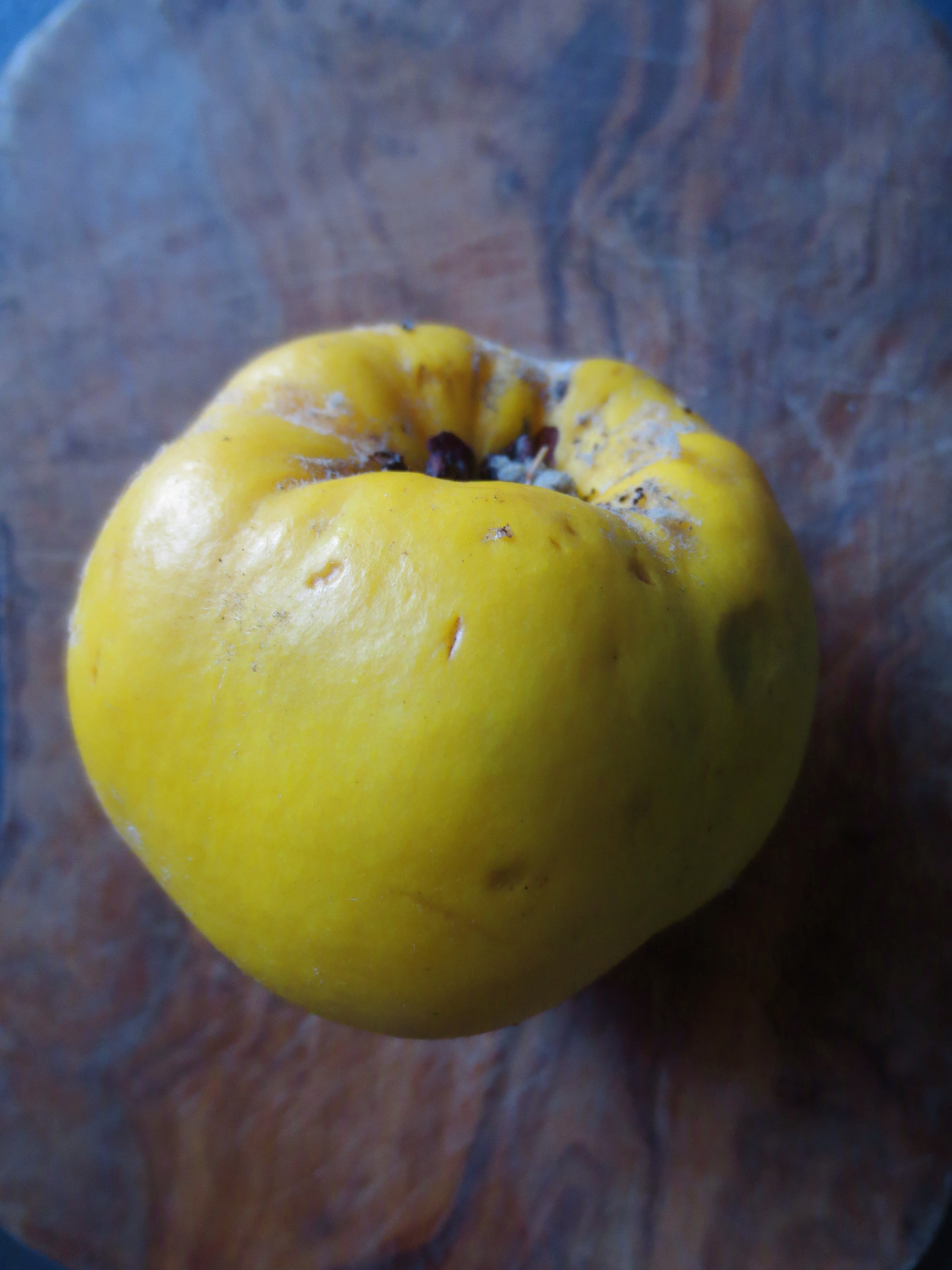
Horseradish and mustard seed. Apples and quinces. A dollop of something that smarts and sears is what is required now. I found the last quinces of the season where I am staying, tiny little gnarled things covered in crystalline cobwebs. Yellow turning to black and as small as tomatoes. And I found some Granny Smith apples that were bunched on a tree in someone’s front lawn. Green, luminous and numerous and unpicked. The rest of the garden was bare and suburban. But the apples were a cartoon green. Perfect and unmarked, with an almost waxy sheen.

“Excuse me, can I help you?” the voice behind us was arch and querulous. I quickly retreated my camera. We turned on our best smiles. “We were just admiring your lovely apples” I said. “Well, come on then, I’ll give you a tour. You can have some if you want.” I promised her a jar of spiced apple jam in return and she perked up. We followed her round her plot and listened to the story of how they bought the house, 40 years ago, and how before that the actress Dame Sybil Thorndike would sit in the conservatory and ‘be round the bend.’

“Won’t you come in? You haven’t eaten? You must be hollow.”

We walked into the house. It too had been untouched. Simple and spartan and her husband Colin was also both these things. Small, white-haired and dainty. He was writing Christmas cards but when we came in he looked up as if he’d been expecting us and started talking as if it was a continuation of an earlier conversation. Our hostess went off to make coffee and came back with a cafetière. She was unsure what was in it; tea or coffee. “Perhaps it’s the most revolting thing you’ve ever drunk?” She enquired smiling and I ate a soft biscuit. The songbook of the musical Cats sat on a side table.

We talked about Cornwall – they had just sold a holiday home in Looe. Very pleasant, pronounced Colin. I had spent some time in Cornwall as a child when my dad moved there. “You probably won’t have heard of the place,” I said, “because it was a tiny hamlet on the edge of Bodmin Moor called Henwood. It had a riding school.” “Oh, we know it well,” cried Colin, in his soft burr. “Do you know Ted and Mary?”

IMG_2511

“Now tell me again – where do you live?”

Joe and I paused. He was sitting in a too-small green chair drinking tea-coffee. What do we say? Los Angeles? But we’re English, it was all too complicated. “Ormond Drive” said Joe, where we’ve been for exactly two days, house-sitting. Free-basing, I suppose you could call it, in Hampton, suburb of London, green and leafy, not really a town. A town lite, heavy with history. Colin got out his Cats songbook, and started to read from Growltiger’s Last Stand.*

His bucko mate, Grumbuskin, long since had disappeared,
For to the Bell at Hampton he had gone to wet his beard;
And his bosun, Tumblebrutus, he too had stol’n away-
In the yard behind the Lion he was prowling for his prey.

“We should really push off now. We haven’t done any shopping”, Joe said. “Oh, yes of course. We’ve ruined your morning”.

“And the apples?” Joe asked, as we stood on the threshold. We put on our winning smiles again. Colin gave us an apple each. I was expecting more of a flurry, and two seemed a paltry sum. It was enough for one jar only, which I had promised them. And they had asked us in, they knew Ted and Mary. It was Christmas. Colin had read us poetry. Time to be kind.

IMG_2542

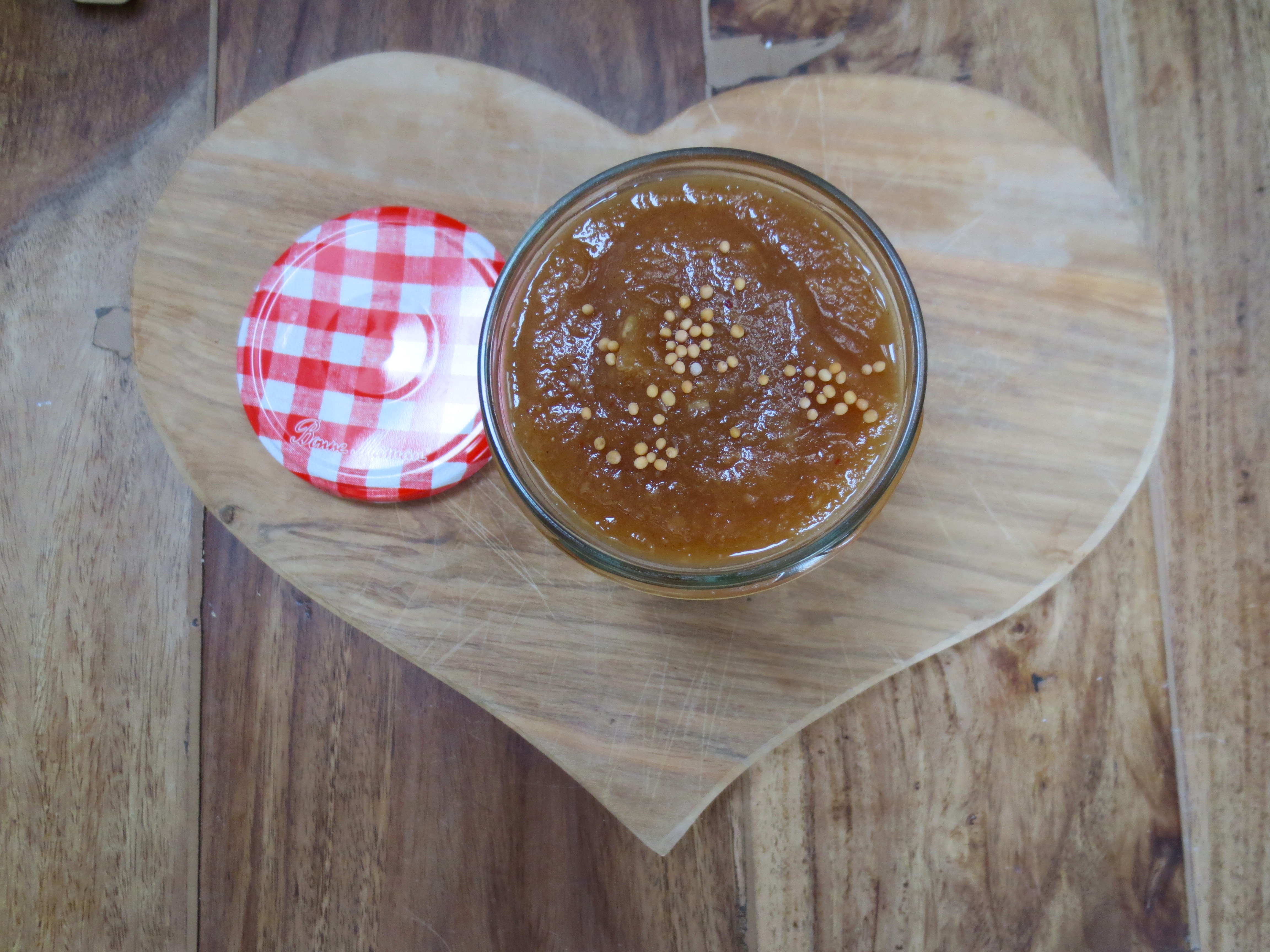
Spiced quince, apple and mustard jam

Adapted from Felicity Cloake, The Guardian

Like its cousin, the apple, quince makes a wonderful pairing with pork (think Christmas ham), but is good with any fatty meat. The sweet spices, and the warm hit, make this jam an especially good partner for cheddar or other hard cheese. English quinces are now all but over, unless you can find a few malingerers as I have here, but Cypriot and Turkish grocers, and Middle Eastern shops will have their luscious and bulbous imports, so there’s no excuse. Ginger can be used here instead of horseradish, or as well as.

500g ripe quinces (or a mixture of quinces and apples)

1 shallot, finely chopped

100ml cider vinegar

175g light muscovado sugar

5cm horseradish, peeled and finely grated (or ginger)

½ tsp cinnamon

1 tsp mustard seeds

2 tsp mustard powder

Peel the quinces, cut them into sixes, remove the cores, then roughly chop the flesh. Put the fruit in a pan and cover with cold water. Bring to a boil, reduce the heat to a simmer, and leave to cook for half an hour until soft. Drain, then mash or blitz to a pulp in a blender.

Put the quince back in the pan with the remaining ingredients, except for the mustard seeds and powder. Cook for about 20 minutes, until thick, then take off the heat and leave to cool. Stir in the seeds and mustard powder. Decant into a sterilised jar (washed with soapy water, rinsed and then put in a hot oven for ten minutes) and refrigerate.

* Originally from Possum’s Book of Practical Cats by T.S Eliot

Share this:

  • Share on X (Opens in new window) X
  • Share on Pinterest (Opens in new window) Pinterest
  • Share on Facebook (Opens in new window) Facebook
  • More
  • Share on Reddit (Opens in new window) Reddit
  • Share on LinkedIn (Opens in new window) LinkedIn
  • Share on Tumblr (Opens in new window) Tumblr
  • Print (Opens in new window) Print
  • Email a link to a friend (Opens in new window) Email
Like Loading...

Always winter

04 Wednesday Dec 2013

Posted by Sophie James in Recipe

≈ 25 Comments

Tags

Almonds, Baking, Cake, Childhood, Chocolate, Dessert, Devon, Ingredients, Nonfiction, Recipes, Stories

IMG_2251

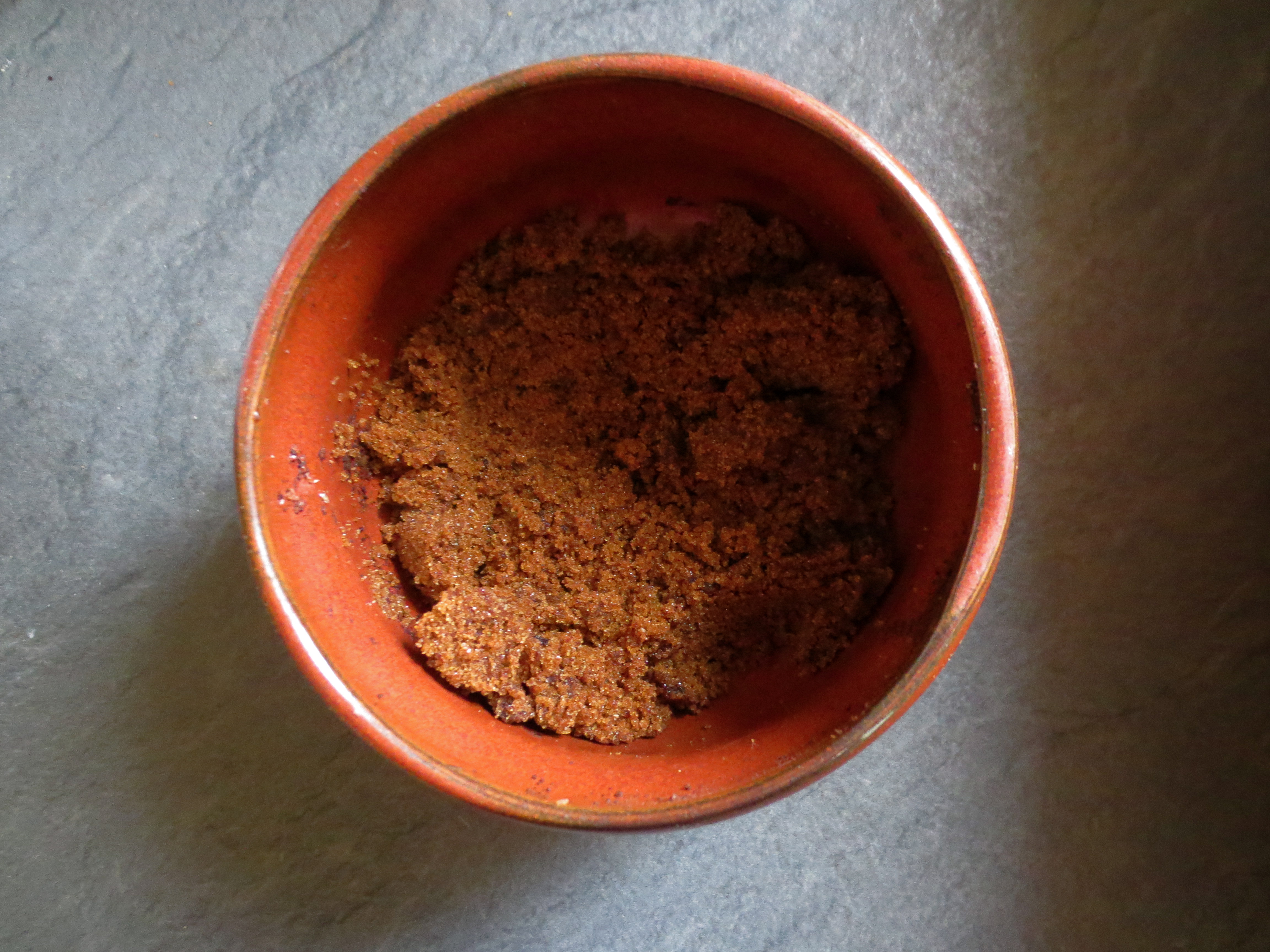
Perhaps it’s because I have been spending a lot of time in the mud, but I’m drawn very much to muscovado sugar. Dark as earth, moist, crumbly and rich with minerals, it has sizeable heft. It is always winter with muscovado. And it reminds me of the eternal cold of Devon, before central heating, and the way our small fingers stuck to the inside of the windows and having to get dressed with our foggy breath snorting out of our mouths like buffalo.

As children we only ever had muscovado and we put it in our tea, which was like drinking turf. We sprinkled it over our porridge in the mornings and the strong malt-like aniseed depth of it was not always easy to take, though it helped if there was a moat of cold milk which the muscovado sweetened to butterscotch. If muscovado is turf then molasses is tar. It was sometimes given to us ‘for nerves’ in the same way that cod liver oil was administered ‘for bones’. And I can still remember the thick gluey strings of molasses making my jaw ache, the smell strangely reminiscent of tobacco and the colour which was like Victorian yacht varnish.

I was aware that other households didn’t have such things. My school friends had white sugar that was often mistaken for salt, and a wet dab of the finger was needed to ascertain which was which. I also remember that theirs were houses filled with neatness and pullovers and tank tops knitted in luminous artificial colours.

011

My friends didn’t have to be wrapped in sheets stiff with heat from the storage heater just before bedtime. They didn’t know what they were missing, because being swaddled like this so you could barely move and feeling the starchy steam rise into the room was actually very satisfying. And then we were lowered into our beds like mummies. But apart from this one thing, I really wanted to be banal and suburban and have nothing unique about me at all.

This might be why I called myself Marian, which I did for a while, thinking it was a nice, quiet name. But the black sugar was too much of a give away. It marked us out as odd and therefore vulnerable to attack. And it wasn’t used for things people understood, like chutneys, marinades and fruit cake. It spoke of the chaos underpinning everything, that we used muscovado outside of its real purpose, that we didn’t differentiate. Eventually we left, dad to Exmouth and the rest of us to Exeter and later onwards to London. It has left me with a lifelong nervousness of parochial life, of so-called ‘country living’. Those small places can be tough. But muscovado put iron in the soul and molasses helped to calm our fraying nerves.

IMG_2475

The lowdown on muscovado

Muscovado (from the Portuguese açúcar mascavado meaning ‘separated sugar’) is also known as Barbados sugar, and is made differently to other brown sugars: instead of being white sugar to which molasses is added, it is boiled down from sugar cane juice, purified with lime juice, but then not refined any further. Muscovado is made in Barbados, in Mauritius, and in the Antique province in the Philippines, where it was one of the most prominent export commodities, from the 19th century until the late 1970s. It is nutritionally richer than other brown sugars, and retains most of the natural minerals – such as calcium, phosphorus, magnesium, potassium and iron – inherent in sugarcane juice.

Muscovado brownies with almonds

Adapted from Claire Thomson, The Guardian, Cook, 13/2/2016

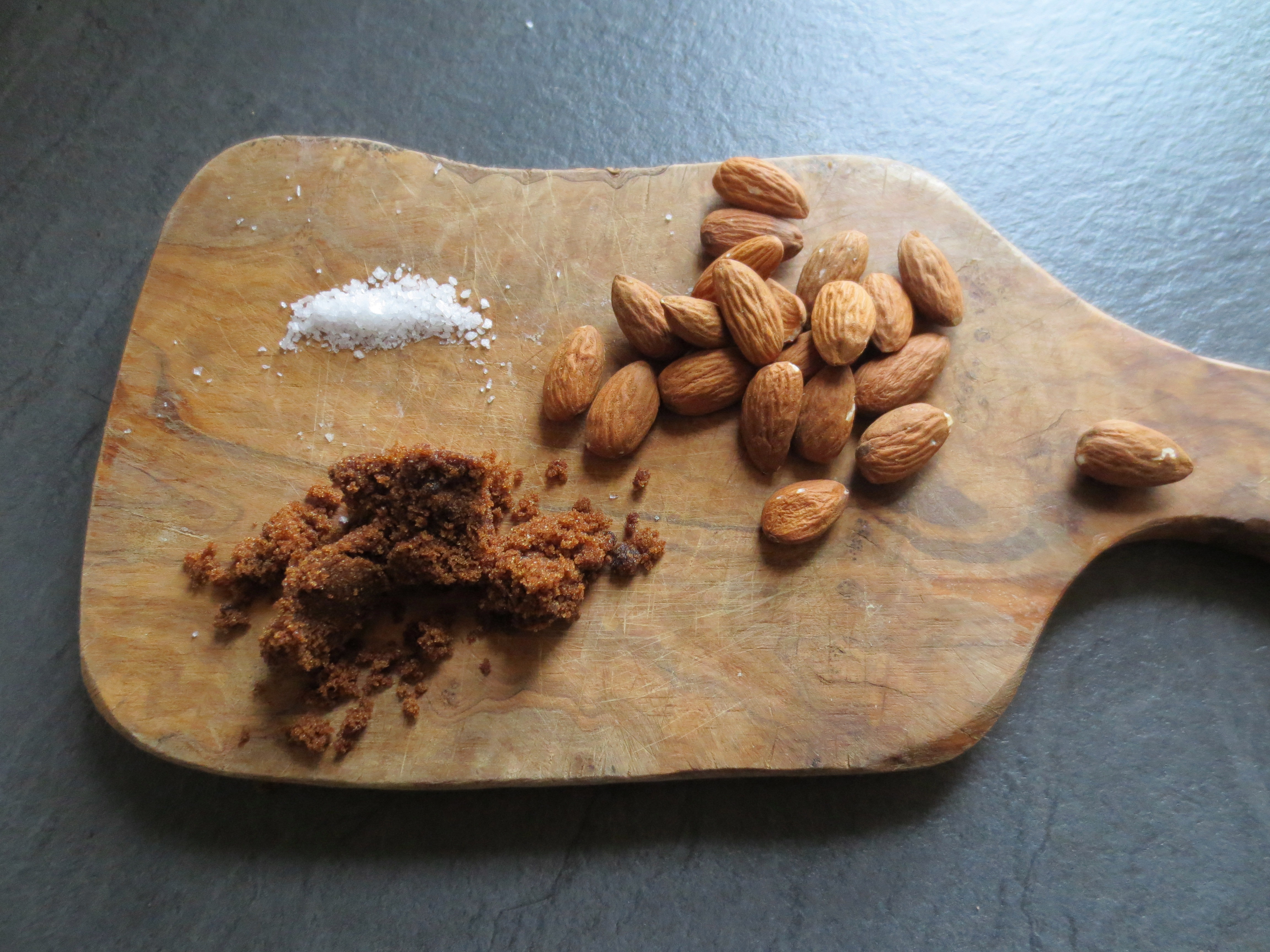
You can use whatever nut takes your fancy, but almonds always work with this recipe and you can keep the skins on. Walnuts are also lovely as are prunes. This is on the ‘weeping’ end of the brownie spectrum – crisp on the outside and damp within. My earlier brownie recipe is even more luxe. I’m terrified now looking back at those ingredients; you will probably need a defibrillator standing by, just in case. This recipe is a bit more demure. Make it gluten-free by using rice flour or a gluten-free mix instead of the standard plain. You can go the whole hog here and only use dark muscovado or light muscovado if you want to forgo the caster sugar. 

125g almonds (or walnuts/softened prunes, drained and roughly chopped)

150g dark cooking chocolate (60-70% cocoa solids)

150g unsalted butter

3 eggs

100g dark muscovado sugar

100g caster sugar

100g plain flour

15g cocoa powder

1/2 tsp salt (plus a pinch to sprinkle over the baked brownie)

Lightly grease a non-stick baking tin 6 x 10 inch (15 x 24 cm) and line with baking parchment. Allow the paper to come 1 inch (2.5 cm) above the tin. Heat the oven to 350F/180C, then chop the almonds roughly, put them on a baking sheet and toast in the oven for about 5-8 minutes, keeping an eye on them as they burn easily. Use skin-on or blanched, both are fine.

While the almonds are doing their work, put chocolate and butter together in a heatproof bowl fitted over a pan of barely simmering water. Allow the chocolate to melt without stirring it, then remove from the heat and gently stir to smoothness.

In a separate bowl, beat the eggs and sugars together until the mixture is creamy and thick. Mix the melted chocolate and butter into the egg and sugar mixture.

Sift the flour and cocoa powder and salt into the chocolate mixture. Beat together until smooth. Fold in the almonds.

Pour the mixture into the prepared tin and bake on the centre shelf for 20 -25 minutes. Don’t overcook the brownie – you want it to be just firm to the touch (not scorched at all) and still gooey inside. Leave to cool for ten minutes, and then put on a sheet of parchment on a wire rack. Cut squint, so you can eat the stray bits while no one’s looking.

Share this:

  • Share on X (Opens in new window) X
  • Share on Pinterest (Opens in new window) Pinterest
  • Share on Facebook (Opens in new window) Facebook
  • More
  • Share on Reddit (Opens in new window) Reddit
  • Share on LinkedIn (Opens in new window) LinkedIn
  • Share on Tumblr (Opens in new window) Tumblr
  • Print (Opens in new window) Print
  • Email a link to a friend (Opens in new window) Email
Like Loading...

Ripe

23 Saturday Nov 2013

Posted by Sophie James in Recipe

≈ 24 Comments

Tags

Autumn, Cooking, Dessert, Fruit, Ingredients, Los Angeles, Recipes, Spices, Stories, Sussex, Unbuyables

020

Steaming pineapples and musky roses. Damp, heady and sweet. A bit like a fruit and veg shop. That’s the best I can do when it comes to describing the strange perfume of quinces. Warm and wet? Sultry. They smell like perfume. I’m at a loss.

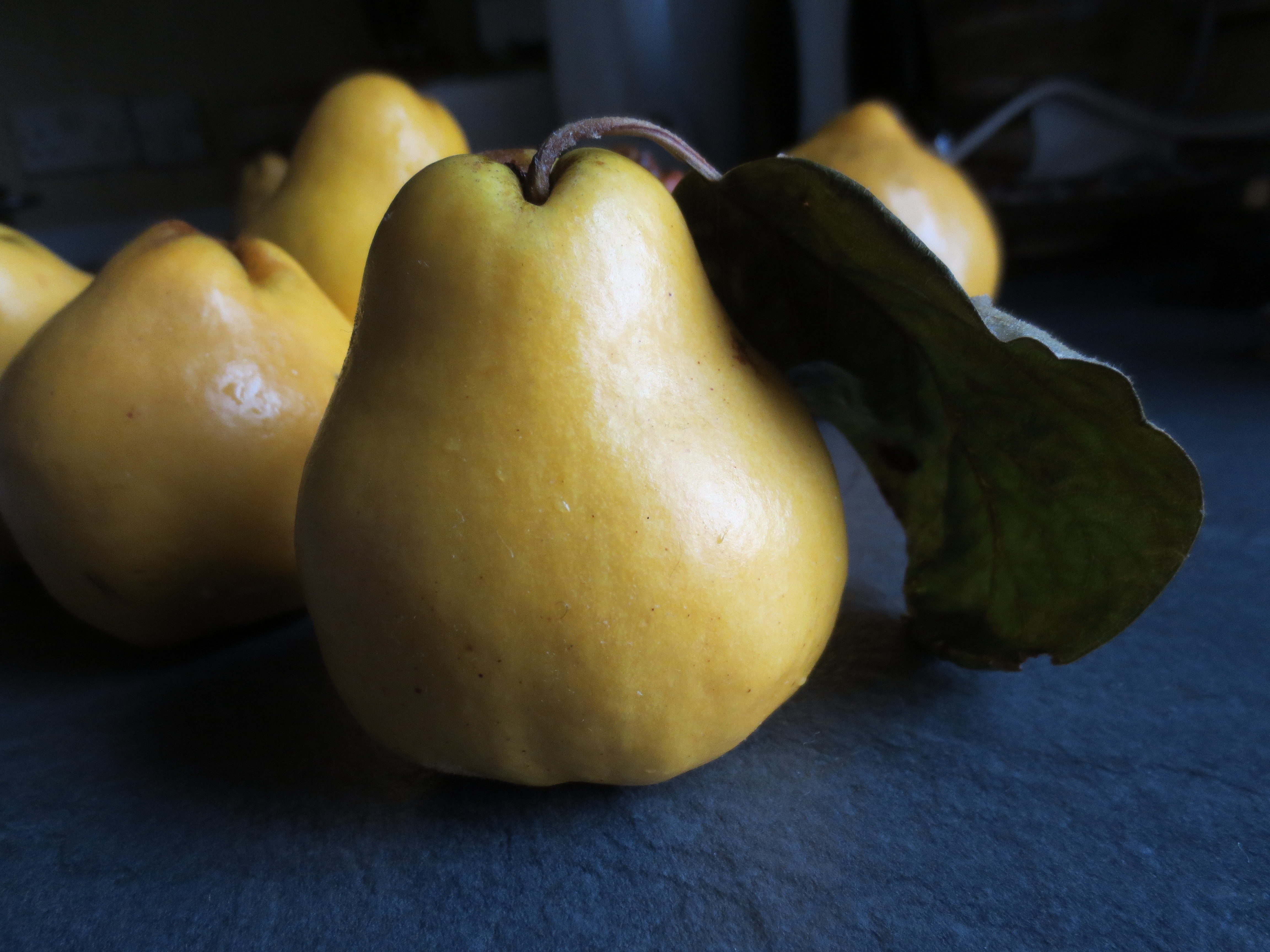
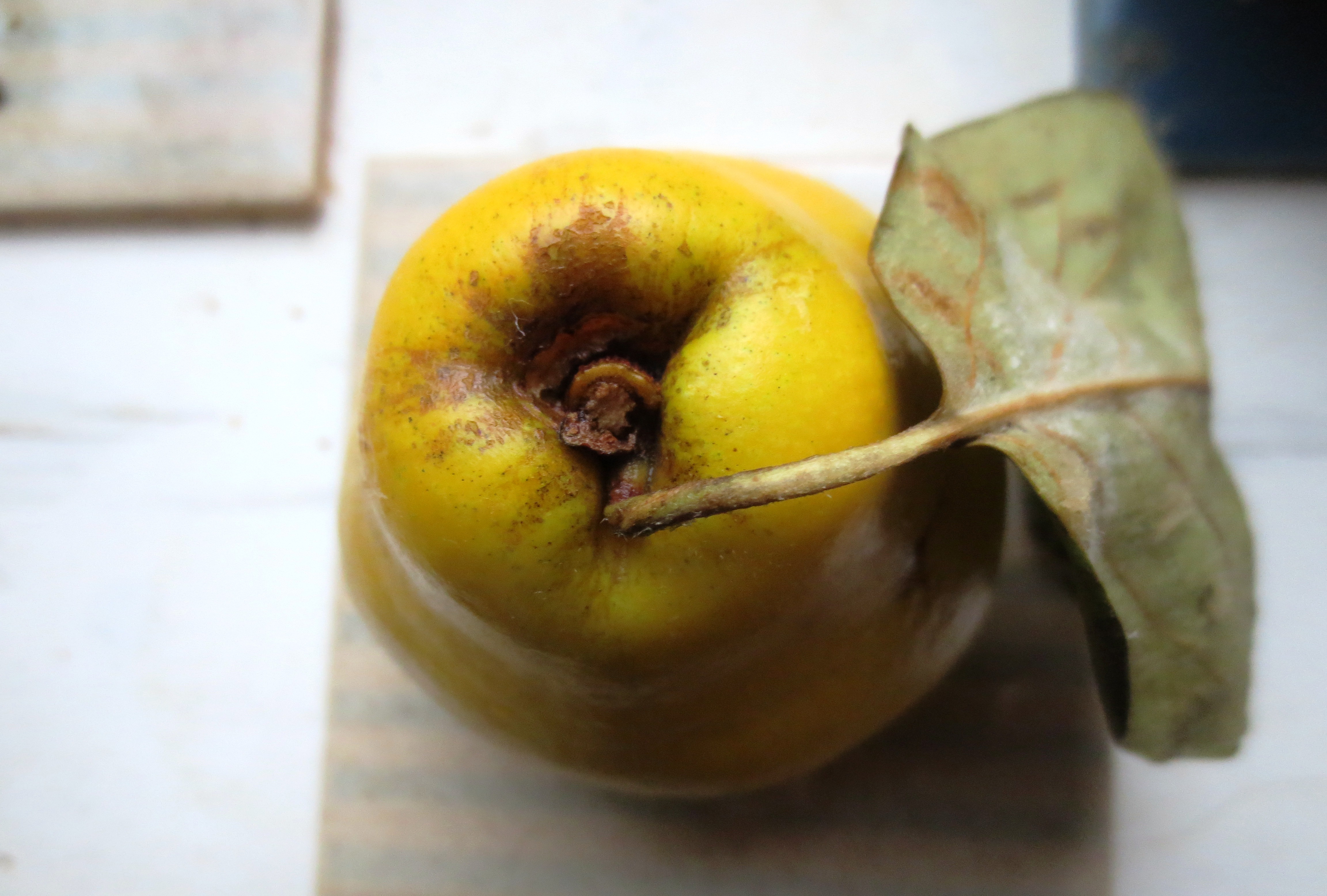
This is also what happens when I’m asked (and this happens a lot) “how do you find LA?” I haven’t yet found it, I want to say. I’m still at a loss. Sometimes words are tricky and some things are hard to grasp. There’s no ‘it’, there’s no graspable thing. The quince is yellow when ripe and is almost waxy, and it smells definitely of pineapples. It is hard in the hand – there’s no give in it, unlike a pear which it resembles. A pear with a big bum. You can’t eat it raw unless you like having bloody stumps instead of teeth. You have to wait for the fruit to become bletted, which means soft to the point of decay, if you want to eat it like that. The quince needs to be cooked, and then there’s the smell (see above). It’s probably what is known as an acquired taste.

LA is dry and hot and sunny most of the year. Sometimes it rains and then it buckets down and no one knows how to drive when the road is wet so they crash. There is no centre, but lots of grids. So if you get lost, then you just take the next left and go backwards. It is a maze of suns. Everyone wears sunglasses all the time, even at night. It is a city of endless fragments where you are unlikely ever to bump into anyone you know. If you want to get lost, it’s a good place to be.

There is a huge botanical garden, The Huntington, with a library attached that has the first edition of Darwin’s The Origin of the Species. Oskar Schindler lived above a dry cleaners in Beverly Hills for a while. David Hockney learned to drive in LA (and drove all the way to Las Vegas after his test, because he didn’t know how to get off the freeway), as did I. The smell of wild fennel is strong, and I would say it is a place of colour. It is rarely damp.

Quince

I found these quinces in a bag on someone’s front lawn on the outskirts of Seaford. Previously there have only been apples there, so discovering quinces was very exciting. I hope it was okay for me to take them. I took all the other things they left out, and nobody said anything. You are unlikely to find local quinces in the shops. Along with mulberries, you’re better off befriending someone with a tree and a glut and a kind heart. It is worth it.

One of the many spectacular things about quinces is the way they turn a deep rosy gold during cooking, which makes them rather dramatic and a bit serious-seeming. Good for dinner parties, or just on your own, slumped over a book. This compote is lovely served with yoghurt, cream or ice cream. Good as a sorbet too, or puréed for a tart.

bowl of quinces

Compote of quinces and allspice

Inspired by Jane Grigson’s Fruit Book, originally from Audiger’s La Maison Reglée, 1692

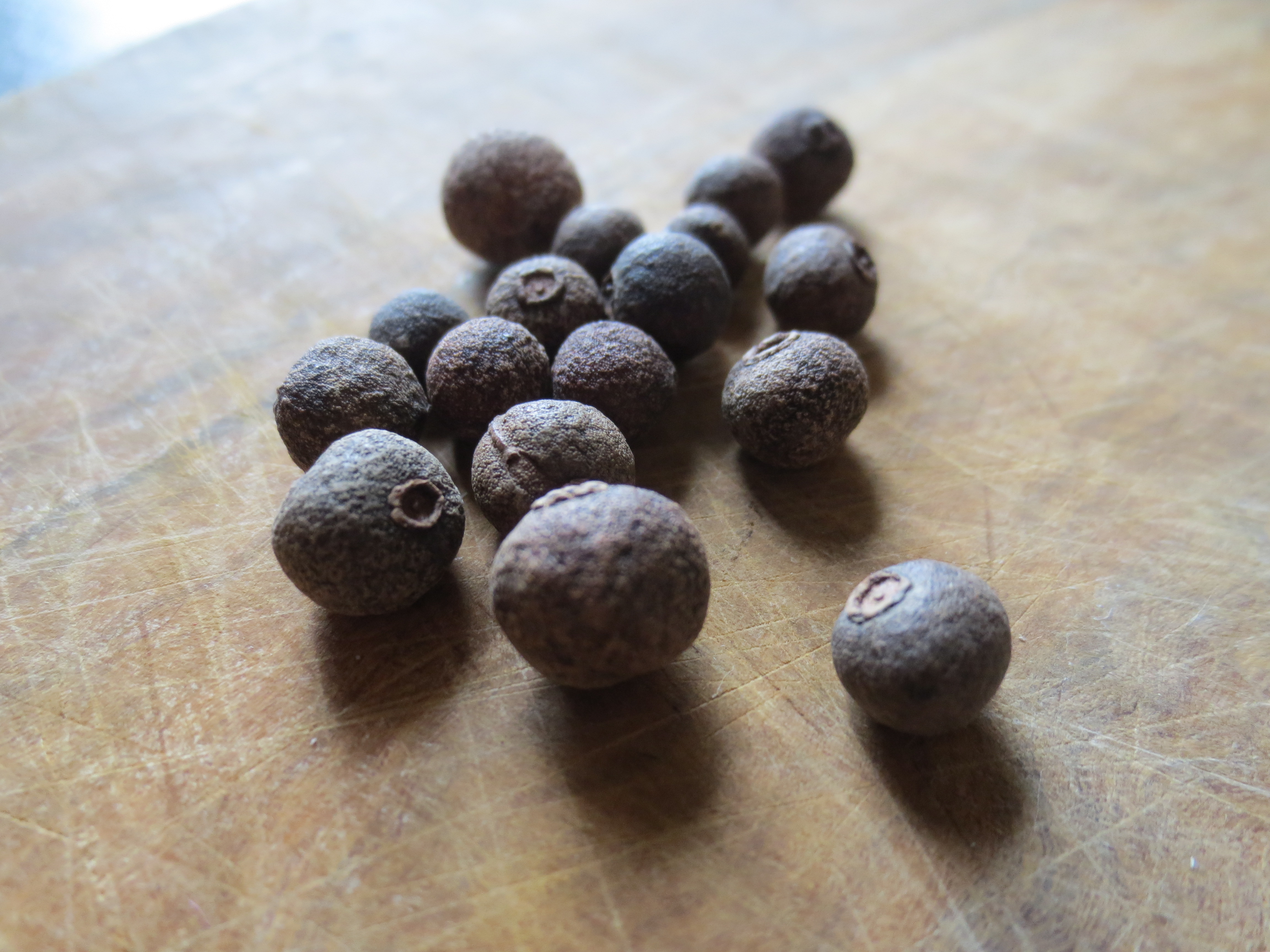
Allspice isn’t, as I once thought, a combination of ‘all the spices’. The name was coined around 1621 by the English, who likened its aroma and taste to a combination of cinnamon, nutmeg and cloves. Allspice (Pimenta officinalis) comes from a tropical tree native to America, also cultivated in the West Indies and Jamaica. The berries – as seen below – are often tied in muslin and used in the making of preserves and pickles. The flavour, like the quince, is elusive, and works well here.

6 quinces (or thereabouts)

Sugar or honey to taste

3-4 Whole allspice berries

Cut up two quinces – use windfalls for this, as it doesn’t matter what they look like – and put them, peel, core and all into a pan. Cover generously with water. Also peel neatly the four remaining quinces. Add these peelings to the pan, and then the cores as you cut them into quarters. The cores are very tough, so pare gradually away otherwise you’re left with shards and splinters of quince.

Prevent the pieces from discolouring by dropping them into a bowl of lightly salted water. Boil up the pan of quince ‘debris’, and stew lightly until it begins to turn a rich amber. Not red as many suggest – you’ll be waiting forever for that. Now strain off the glowing juice, add sugar or honey* to taste, and bring slowly to simmering point, stirring every now and then. In this syrup, cook the quince pieces along with the allspice berries, until the fruit is tender. Serve with something white and cool.

Quinces further away

IMG_2118

Allspice berries

Other recipes with quince:

Quince paste with Manchego

*I have not used honey in the making of this recipe so far, though it was used traditionally, before the advent of sugar. However, you may need to experiment with the strength and sweetness, as honey behaves differently to sugar in the cooking process.

Share this:

  • Share on X (Opens in new window) X
  • Share on Pinterest (Opens in new window) Pinterest
  • Share on Facebook (Opens in new window) Facebook
  • More
  • Share on Reddit (Opens in new window) Reddit
  • Share on LinkedIn (Opens in new window) LinkedIn
  • Share on Tumblr (Opens in new window) Tumblr
  • Print (Opens in new window) Print
  • Email a link to a friend (Opens in new window) Email
Like Loading...

The short life of pears

12 Tuesday Nov 2013

Posted by Sophie James in Recipe

≈ 16 Comments

Tags

Autumn, Cooking, Dessert, Fruit, Ingredients, Lucas Hollweg, Recipes, Somerset, Spices, Stories

img_1879-2

There was a pear tree outside the window in Watchet. Conference pears that suited the palette of the place. Seaford was grey – pewter grey, oyster grey, pinky grey after the sunset. And Watchet was the full spectrum of brown. Deep russet, rust, coral red, the sand on the beach brown like earth, the red earth in the fields slack with rain, giving us all ‘ginger boots’ (dad’s phrase). High iron deposits in the soil, that’s what.

And even though there were tons of apples – in fact so many no one knew what to do with them all – pears were what we ate. And I love pears. I’d rather eat a pear than an apple. No peeling required. The juice is more forthcoming in a pear, the softness a surprise.

IMG_1861

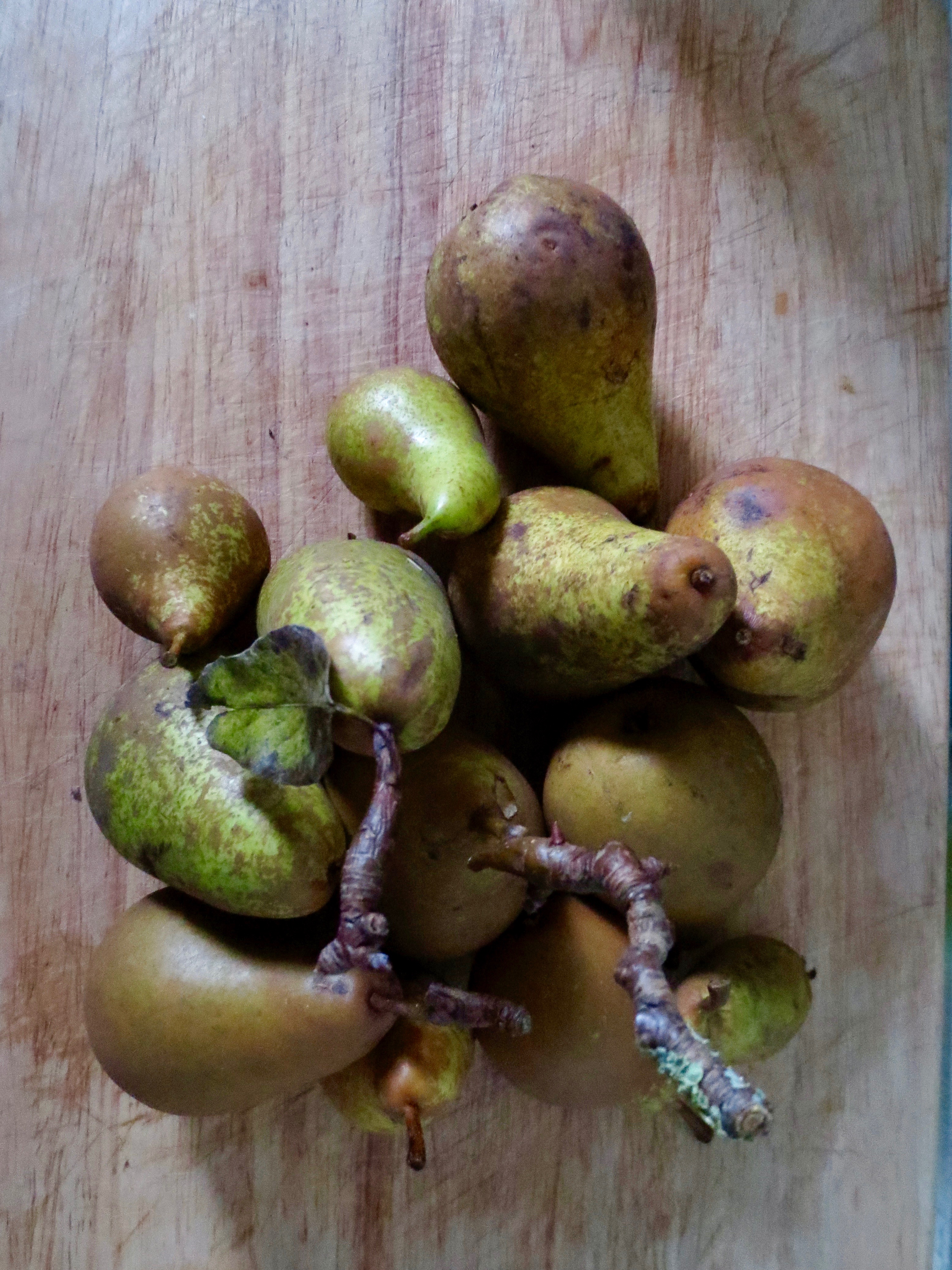
I was allowed to pick the pears, as many as I wanted. A lot had fallen on the ground, and were in the process of rotting back into the earth. It was the perfect time for them, almost to the day – ‘the tradition is to pick them on or soon after 1 November and then watch them as they come to perfection’ according to R.H.L Gunyon – and it was lovely to see how many sizes they came in, unlike the Stepford Wives versions I’m so used to seeing at the supermarket.

They were all hard, but this is normal. They should be picked firm and allowed to ripen at home. A ripe pear yields slightly around the stem, but doesn’t split or feel squashy. I ate pears two ways during my stay in West Somerset. The ones I picked I didn’t eat until five days later. I was unconvinced they would work out, but I kept them in my bag, ready.

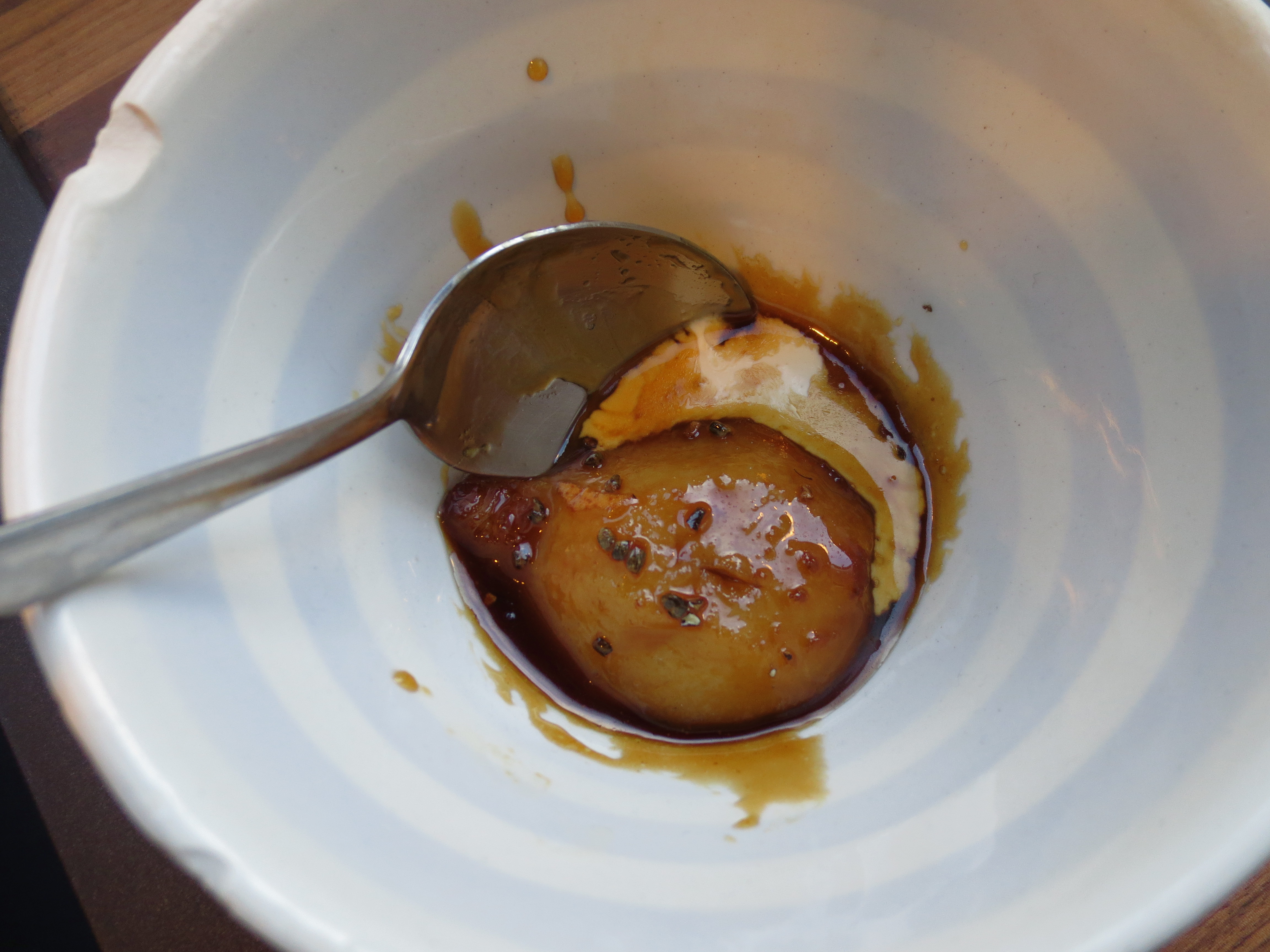
The first pears I encountered were cooked; they were buttered, sugared, salted, spiced with ginger and cardamom, and phenomenally rich. It was hard to talk about them during or even after eating. My cousin Becky cooked them, following Lucas, her brother’s recipe. Made in the Aga, with crates of apples out the back. I remembered how Lucas used to read cookery books as a child in this house, and now here we were eating his gingery pears, reading them as we were eating them, his limpid prose coming from the shiny page. There are ten minutes in the life of a perfect pear, he wrote. Best get on then, as they say down this way.

IMG_2017

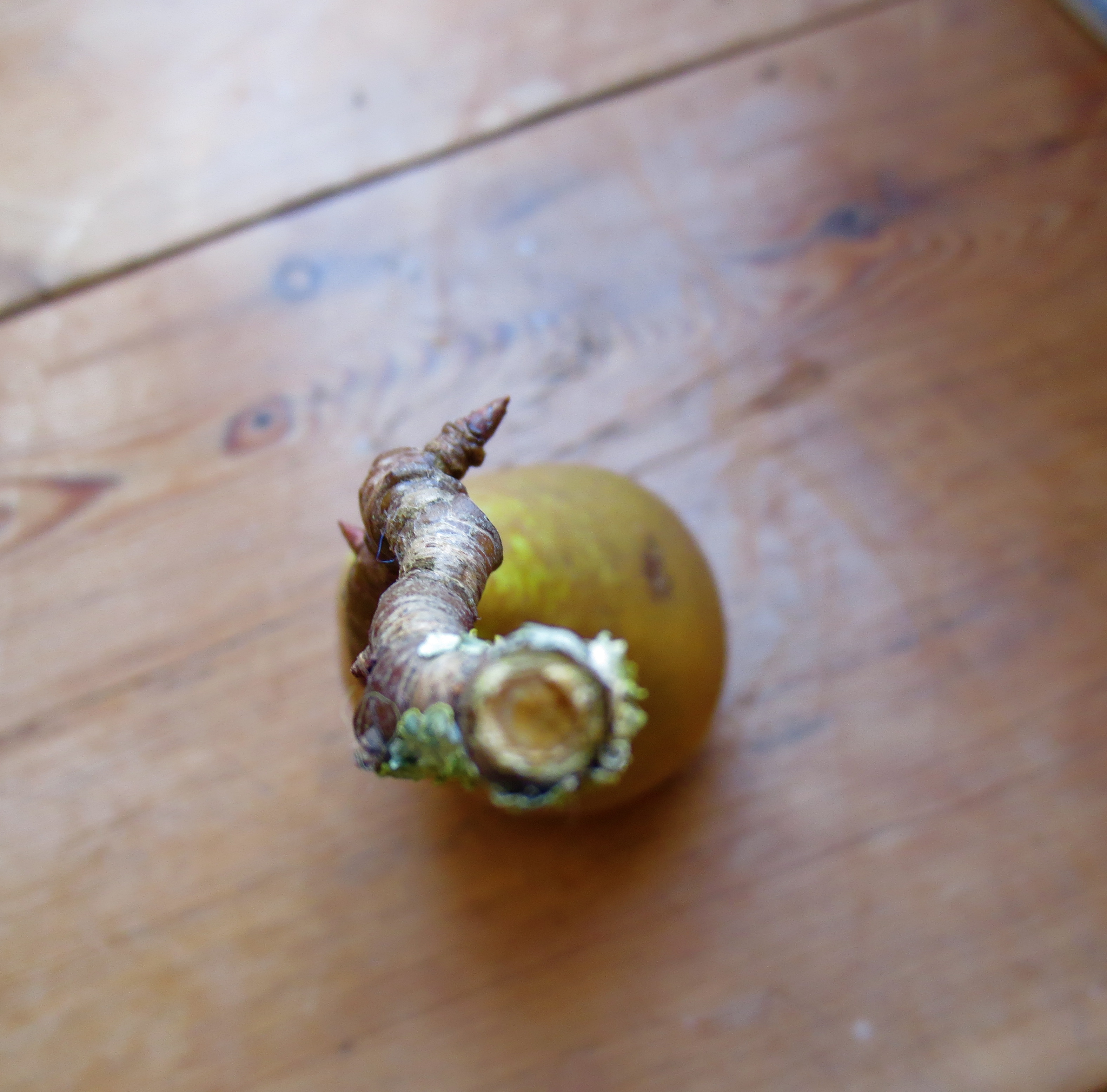
On my last day, I picked more pears from the tree, and put them in my bag. None of them felt ready to eat. Even the ones from my first day felt disappointingly robust. Dad drove me to the train station. Another cancelled train. What is it with me and trains?  The cancellation this time was due to the existence of ‘disruptive passengers’. We got back in the car. It was two hours until the next one and we were both hungry. It was pouring with rain and now it was cold; proper weather at last.

We ate smoked mackerel and pears while listening to a radio programme about drug overdoses. The pears were perfect. The mackerel was greasy – the savoury to the pear’s sweet. We wiped our hands on an old towel. And because we had two hours, we talked about our memories of things past.

Strange what being in a stationary car will do. I almost missed the next train. The conversation felt too short and suddenly I was out in the driving rain, just in time for the 7.05, the hems of my trousers slopping about in muddy pools. No more pears now, but I’m glad for both lovely meals. Pears cooked, pears raw. Short-lived and perfect.

IMG_2018

Caramel pears with ginger and cardamom

Recipe by Lucas Hollweg, originally in Waitrose Kitchen, October, 2013

Pears in cooking often need a little something – another fruit or spice. Lemon juice is good, because it also helps to arrest the pear’s discolouration after peeling. Pears and apples, pears and quinces, pears and greengages, pears and cheese, pears and bay etc. Here Lucas uses cardamom and ginger to spectacular effect – a pudding that tastes of the coming winter. Don’t be shy of the salt.

Serves 4-6

 50g unsalted butter

75g dark brown sugar

75g granulated sugar

¼ tsp sea salt flakes

1½ tsp ground ginger

12 green cardamom pods

4 medium pears, peeled and halved

Preheat the oven to 200C/392F. Put the butter in a saucepan with both kinds of sugar, the sea salt and ground ginger. Using a sharp knife, slit open the cardamom pods and shake out the dark seeds from inside. Chop them with a knife (or grind them lightly in a pestle and mortar) and add to the butter and sugar. Warm over a gentle heat until the butter and sugar have melted together.

Pour into the bottom of a roasting tin or ovenproof frying pan that’s just large enough to fit the pear halves in a single layer. Arrange the pears on top of the sauce, cut side down. Place in the oven for 20 minutes, then carefully turn the pears over, basting with some of the hot sauce, and return to the oven for 20 minutes more. Remove from the oven and leave to cool for 5 minutes. Serve with some of the sugary juices spooned over the top and a glug of double cream. 

Cry loud the pears of anguish

Parisian street sellers, 13th century

Share this:

  • Share on X (Opens in new window) X
  • Share on Pinterest (Opens in new window) Pinterest
  • Share on Facebook (Opens in new window) Facebook
  • More
  • Share on Reddit (Opens in new window) Reddit
  • Share on LinkedIn (Opens in new window) LinkedIn
  • Share on Tumblr (Opens in new window) Tumblr
  • Print (Opens in new window) Print
  • Email a link to a friend (Opens in new window) Email
Like Loading...
← Older posts
Newer posts →

Enter your email address to follow this blog and receive notifications of new posts by email.

Join 2,216 other subscribers

Top Posts & Pages

Frilly
Pause
Early Nigel
Plums and Pluots
Recipe List
Power of two

Recent Posts

  • At my allotment
  • A compendium of sorts
  • Mulberries
  • We are nature
  • Leaving home
  • A treacherous herb
  • Just stop it
  • Why I swim

Great books I’ve read

Blogs/Websites I read

  • Letitia Clark
  • Nigel Slater
  • Room to heal
  • Samantha Harvey
  • Stewart Lee
  • The Kureishi Chronicles
  • The Marginalian
  • Tom Cox
Follow Stories from the Stove on WordPress.com

Archives

  • June 2023
  • February 2023
  • September 2022
  • August 2022
  • July 2022
  • May 2022
  • February 2022
  • December 2021
  • August 2021
  • April 2021
  • March 2021
  • January 2021
  • June 2020
  • November 2018
  • August 2017
  • July 2017
  • May 2017
  • April 2017
  • February 2017
  • January 2017
  • November 2016
  • May 2016
  • October 2015
  • July 2015
  • June 2015
  • April 2015
  • March 2015
  • January 2015
  • December 2014
  • November 2014
  • October 2014
  • September 2014
  • August 2014
  • July 2014
  • June 2014
  • May 2014
  • April 2014
  • March 2014
  • February 2014
  • January 2014
  • December 2013
  • November 2013
  • October 2013
  • September 2013
  • August 2013
  • July 2013
  • June 2013
  • May 2013
  • April 2013
  • March 2013
  • February 2013
  • January 2013
  • December 2012
  • November 2012
  • October 2012
  • September 2012
  • August 2012
  • July 2012
  • June 2012
  • May 2012
  • April 2012
  • March 2012
  • February 2012
"A WOW piece!" Claudia Roden on Walnut Bread

Walnut bread

Lucas’s chocolate marmalade slump

Tags

Afternoon tea Allotment Almonds Art Autumn Baking Bread Breakfast Cafes Cake Childhood Chocolate Christmas Citrus Claudia Roden Cookbook Cooking Dessert Devon Dinner Elizabeth David England Exmoor Fish Food France Fruit Gardening Gelato Gluten-free Herbs Home Homesickness Honey Ice cream Ices Ingredients Italy Jam Jane Grigson Lemons London Los Angeles Lucas Hollweg Marmalade Meat Mediterranean Meyer lemons Nature Nigel Slater Nonfiction Nuts Onions Patience Gray Poetry Pudding Reading Recipe Recipes Salad Sea Seasons Soup Spain Spices Spring Stone fruit Stories Summer Sussex Travel Vegetables Winter Writing Yoghurt

A WordPress.com Website.

Privacy & Cookies: This site uses cookies. By continuing to use this website, you agree to their use.
To find out more, including how to control cookies, see here: Cookie Policy
  • Subscribe Subscribed
    • Stories from the Stove
    • Join 2,084 other subscribers
    • Already have a WordPress.com account? Log in now.
    • Stories from the Stove
    • Subscribe Subscribed
    • Sign up
    • Log in
    • Report this content
    • View site in Reader
    • Manage subscriptions
    • Collapse this bar
 

Loading Comments...
 

    %d